Feces cleanup service is the professional removal and decontamination of human or animal waste from a home or commercial property, including the porous materials the waste soaked into. It deals with the pathogen risk and the odor at its source, and contaminated material leaves under regulated disposal. Emergency Cleanings sends licensed, insured local technicians nationwide and locks a flat price after an on-site scope, so families know the number before anyone starts.
Nobody plans for this one. A tenant moves out and leaves a bathroom that hasn’t been usable in months. An elderly parent’s home turns out to be far worse than anyone in the family knew. A commercial property gets broken into and used as a shelter. A sewage line backs up into a finished basement.
What these have in common is that the mess on the surface is the smallest part of the problem — and that most people’s first instinct, to grab gloves and a mop and handle it quietly, is the one approach that reliably makes it worse.
What’s actually in it
Human waste is not simply unpleasant. Feces can carry enteric pathogens including E. coli, salmonella, shigella, hepatitis A, norovirus, giardia, and cryptosporidium. Urine breaks down into ammonia, which off-gasses continuously and, in an enclosed room with poor ventilation, becomes a genuine respiratory irritant long before you’d think of it as dangerous.
Where properties have sat empty, rodents follow the food and the waste. The CDC’s guidance on cleaning up after rodents is blunt about the method: do not sweep or vacuum droppings, because doing so aerosolizes particles that can carry hantavirus. Ventilate the space first, wet everything down with disinfectant, and let it sit before touching anything. That single instruction disqualifies almost every DIY attempt we get called in behind — the shop vac has usually already come out.
The OSHA question, answered accurately
You’ll see a lot of cleanup companies claim that human waste falls under OSHA’s Bloodborne Pathogens Standard (29 CFR 1910.1030). That’s not quite right, and the distinction matters if you’re a property manager or employer deciding what to ask your staff to do.
OSHA’s own interpretation is that urine and feces are not classified as “other potentially infectious materials” under that standard unless they’re visibly contaminated with blood. When blood is present — and in severe hoarding, unattended death, and assault scenes it often is — the standard applies in full, with its training, exposure-control-plan, and PPE requirements.
When blood isn’t present, the bloodborne pathogens rule isn’t the operative one, but that doesn’t leave an employer in the clear. The enteric pathogens above are real, OSHA’s general duty clause still requires a workplace free of recognized hazards, and respiratory protection and PPE standards still apply. The practical reading for a landlord or facility manager: this is not work to hand to a maintenance tech or a janitorial crew as a favor.
Why the surface clean doesn’t hold
The recurring failure in DIY and general-cleaning attempts is that they treat a porous-materials problem as a surface problem.
Liquid waste migrates. It goes through grout, through vinyl seams, into the subfloor, down into the pad beneath carpet, into the bottom plate of a drywall partition. Urine in particular wicks into concrete and stays there — you can bleach the slab until it looks pristine and the ammonia smell returns within a week, because the source was never in the part you cleaned.
Air handling is the other half. A contaminated room that shares a return with the rest of the building will distribute the odor and the particulate everywhere the ducts go. Cleaning the room without isolating it moves the problem instead of solving it.
Which is why the honest test of whether a job was done right isn’t how it looks on completion day. It’s whether the smell is still gone in three weeks.
What a professional feces cleanup service actually does
The work is closer to remediation than to cleaning:
Assessment and containment. Identify the full extent — including under and behind finishes — before anything is disturbed. Isolate the affected area with containment and negative air so nothing migrates during the work.
Bulk removal, wet. Saturate before removal, never dry-sweep or vacuum. Waste and contaminated porous materials are bagged for regulated disposal, not put in the dumpster out back.
Removal of unsalvageable materials. Carpet, pad, affected drywall, sometimes subfloor. This is the step that gets skipped, and it’s the step that determines whether the odor comes back.
Disinfection with the right chemistry and the right dwell time. Hospital-grade disinfectants have a contact time — usually several minutes of visible wetness — and spraying and immediately wiping does nothing. Non-porous surfaces are treated, porous ones are removed.
Odor at the source, then the air. Enzymatic treatment breaks down residual organic material rather than covering it. Air scrubbing with HEPA and carbon handles what’s airborne. Any masking agent used before the source is gone is a red flag.
Verification and documentation. Photos before and after, materials removed, disposal records. For a landlord recovering costs from a deposit, an estate settling an account, or an insurance claim, the documentation is what makes the invoice defensible.
Discretion is part of the job
For families, this is rarely just a cleaning problem. Privacy is one of the most common reasons people put off calling anyone at all — and that’s not irrational. A situation like this feels like something the neighbors shouldn’t learn about.
We handle every job with discretion and confidentiality as a standing policy, not an upgrade. Crews are briefed on the situation before they arrive and on how to conduct themselves in someone’s home. We’ll coordinate with whoever you need us to — a case manager, an adult protective services worker, a sibling in another state — so you’re not the one relaying details you’d rather not repeat.
If you’re comparing companies, ask each of them how they handle privacy before you book. How a company answers that question tells you most of what you need to know.
What it costs, and how to get a real number
The price on a job like this comes from measurable things: the square footage affected, how far the contamination penetrated, how much material has to come out and be disposed of as regulated waste, access and stairs, whether structural drying is involved, and how fast you need it done. Most projects land between $1,500 and $3,500.
We quote a flat fee — one number covering labor, disposal, transportation, equipment, and insurance. Not hourly. You’re never in the position of watching the clock and wondering what the crew’s pace is costing you.
And you get the full and final price before any work begins. You get a 2-hour arrival window and a text with the ETA when the technician is on the way — no waiting around all day. The technician walks the property and documents it, our Project Coordinator calls you with the exact number and the plan, you approve it, and only then do we start. Often the same day.
A 20% deposit holds the slot. It’s refundable if the final price comes in higher than the verbal quote — if the real number isn’t what we told you, you can walk away and get it back.
One thing to be clear about: Emergency Cleanings handles the cleanup and the removal, not the rebuild. If flooring or drywall has to come out, putting it back is a contractor’s job. We’ll tell you exactly what’s being removed so you know what that involves before you commit to anything.
If the number is the obstacle, we offer financing, and many jobs can be phased at a fixed price per phase. For more on how these jobs are priced, see our emergency cleaning services cost guide and our biohazard cleanup cost breakdown.
Related reading: The Dangers of DIY Biohazard Cleanup · Safety Standards and Compliance in a Biohazard Cleanup · Managing Mold and Bacteria in Extreme Hoarding Scenarios
One thing to be clear about: we handle the cleanup and the removal, not the rebuild. If flooring or drywall has to come out, putting it back is a contractor’s job. We’ll tell you exactly what’s being removed so you know what that involves before you commit to anything.
Frequently Asked Questions
How fast can someone get here?
Same-day response is normal. You get a two-hour arrival window and a text with the ETA once the technician is on the way.
Does OSHA treat feces and urine as a bloodborne pathogen hazard?
Not by themselves. OSHA has stated that urine and feces are not covered by the bloodborne pathogens standard unless they are visibly contaminated with blood. When blood is present the standard applies in full. Either way, the pathogens and ammonia make this poor work for a janitorial crew.
Can I just clean it up myself?
A small, fresh mess on a hard surface is manageable with gloves and disinfectant. What DIY cannot fix is waste that has wicked into carpet pad and concrete, and sweeping or vacuuming droppings puts particles into the air. If the smell keeps returning, call an emergency cleanup crew.
What if the waste is part of a much bigger mess in the house?
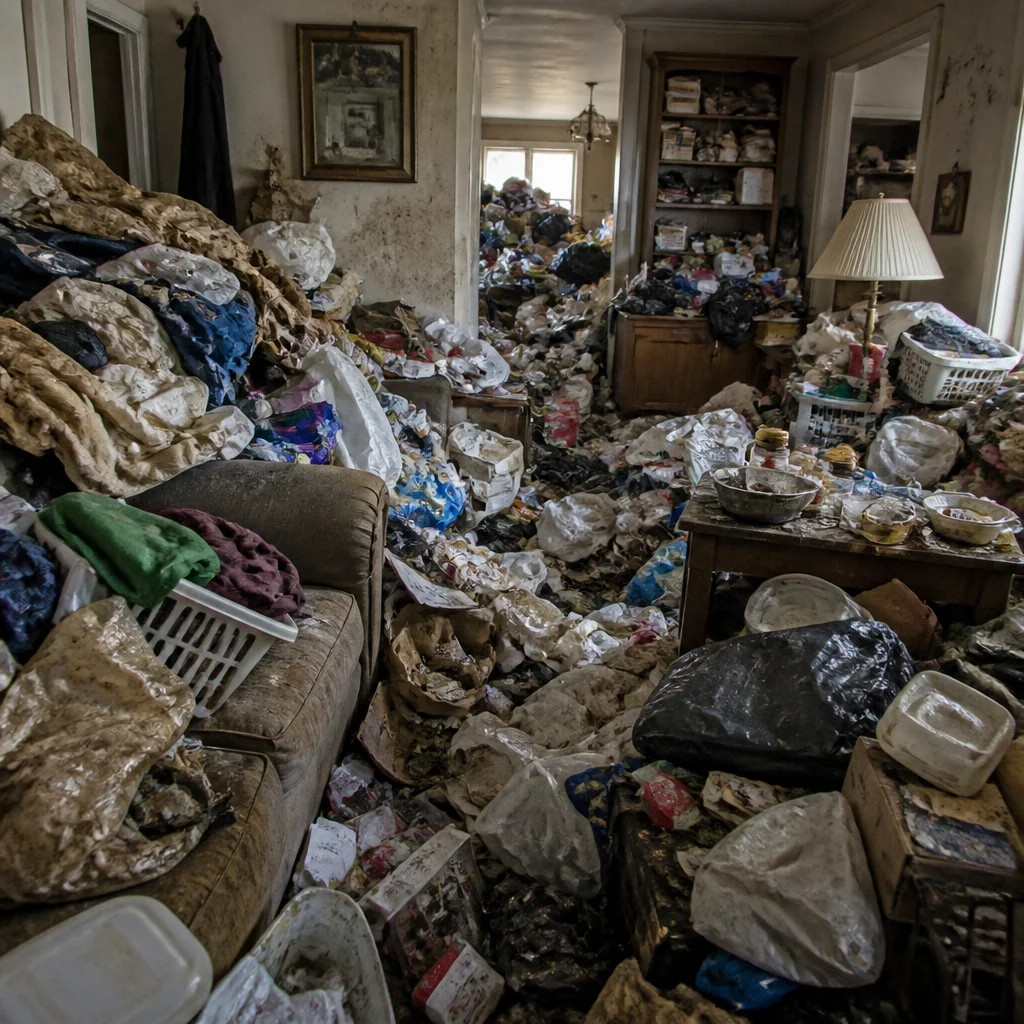
That is common. Heavy soiling often sits under years of accumulated belongings, so hoarding cleanup and decontamination run on one plan. Disposal records are available on request.
How does the pricing work?
Emergency Cleanings quotes a flat fee, locked after a technician scopes the property on site. The assessment is free and you approve the number before work begins. Financing is available, and larger jobs can be phased.
Talk to someone today
If you’re looking at a situation like this right now — in your own home, a rental you own, or a family member’s house — you don’t have to figure out the scope yourself. We’ll walk the space, tell you plainly what has to come out and what can be saved, and give you one flat, final price before anyone starts. We can be there the same day.
Call Emergency Cleanings at 888-560-8488 for a same-day response. The assessment is free. A technician scopes the property on site and your flat price is locked before any work begins.