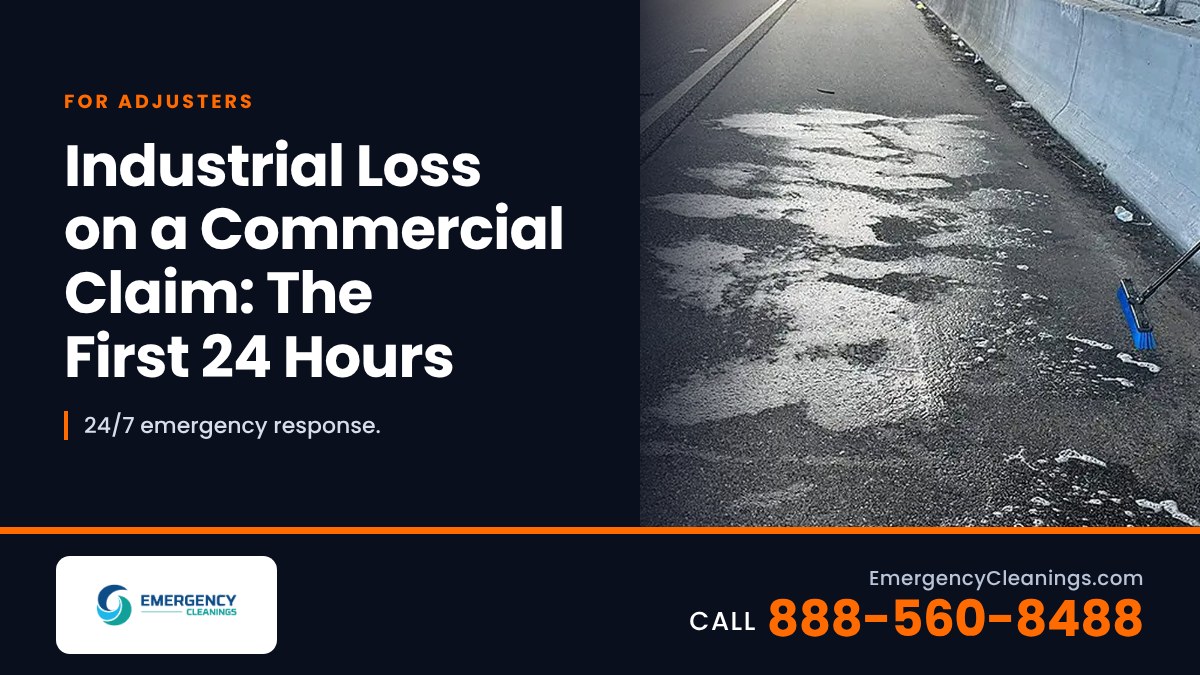
In the first 24 hours of an industrial loss cleanup claim, the insured makes the site safe and locks out damaged equipment, everything gets photographed before it moves, and a cleanup crew scopes the loss on site. Emergency Cleanings handles the cleanup portion only, so production areas can reopen first while restoration and rebuild trades take their own scope.
The first notice of loss comes in from a warehouse or plant. A gearbox let go, a tote ruptured, or an incident left debris across the floor. The risk manager wants the line running, and you need a scope for the industrial loss cleanup claim that you can defend.
Hour 0 to 2: Make the Site Safe
Nobody cleans anything until the site is stable. That part belongs to the insured and their own people.
- Lockout/tagout is the insured’s job. OSHA’s control of hazardous energy standard, 29 CFR 1910.147, requires employers to run an energy control program for servicing machines and equipment. When outside contractors come in, the standard says the on-site employer and the outside employer must inform each other of their lockout or tagout procedures. Confirm the insured’s maintenance team has locked out the damaged equipment before any crew is on the floor.
- Keep people back. Tape off the affected area so employees don’t walk product or debris into clean zones.
Hour 1 to 3: Photograph Before Anything Moves
Once a forklift moves a damaged pallet, the original condition is gone. Ask the insured to shoot the scene first.
- Wide shots of each affected area, then close-ups
- Failed equipment, product labels and container markings
- How far the release or debris traveled
- Undamaged areas nearby, so the loss boundary is clear
Our post on the cleanup job file your adjuster wants to see covers what to keep from here forward.
Hour 2 to 6: Get the Cleanup Crew Scoping on Site
A desk estimate on an industrial loss tends to turn into a supplement. A technician in the building can measure the affected area and note what has to be hauled away.
With Emergency Cleanings, a technician does a free on-site assessment and photographs the loss. A project coordinator then calls with the written scope and one flat price. Once the scope is set and approved, the price holds. Details on what the crew handles are on our industrial cleanup service page.
Separate Cleanup From Restoration and Rebuild
Clean lines between trades make the file easier to defend. We do cleanup only, so we can work beside the restoration GC on the same claim.
Cleanup on an industrial loss usually covers:
- Removing debris from the incident
- Cleaning up released product or oil residue on floors and equipment surfaces
These stay with other trades on the claim:
- Equipment repair or replacement
- Water damage restoration and structural drying
- Fire restoration and mold mitigation
- Structural repair and rebuild
When each invoice lines up with its own scope, you avoid overlap between vendors on the same square footage.
Hour 6 to 24: Restore Production Areas First
Business interruption keeps running every day the facility can’t produce or ship. Sequence the cleanup around operations.
- Production lines and loading docks first. These are usually what restart revenue.
- Aisles and access routes next. Forklifts need safe paths to working areas.
- Storage and low-traffic areas last. These can often stay taped off while the rest of the plant runs.
Ask the risk manager which areas matter most to the insured’s output, and put that order in the written scope. For a fluid release on the plant floor, our hydraulic oil leak guide walks through the same timeline from the plant’s side.
Disposal Records You Can Request
The file should show where the waste went. EPA explains that the Resource Conservation and Recovery Act gives it authority to manage hazardous waste from the moment it is generated to its final disposal. Whether a given waste stream is hazardous depends on what was released, so the insured’s environmental contact should weigh in.
Ask for disposal records at the start, so they arrive with the invoice and match the scope line for line.
Frequently Asked Questions
Who handles lockout/tagout after an equipment failure?
The insured. OSHA’s standard at 29 CFR 1910.147 puts the energy control program on the employer, and outside contractors and the on-site employer must share their lockout or tagout procedures with each other.
Does Emergency Cleanings do restoration or rebuild work?
No. Emergency Cleanings handles cleanup only, including debris removal and cleanup of released product. Water damage restoration, fire restoration, mold mitigation and rebuild stay with other trades on the claim.
How is the cleanup priced?
A technician scopes the loss on site at no charge. A project coordinator then calls with a written scope and one flat price, agreed before work starts, and the price does not move once the scope is set.
Can I get disposal records for the claim file?
Yes. Disposal records are available on request. Ask for them at the start so they arrive with the invoice and match the written scope.
Get the Cleanup Scoped Today
Call 888-560-8488 as soon as the insured has the site safe. We offer same-day response and a free on-site assessment, and you get a written scope with one flat price locked before any work starts.