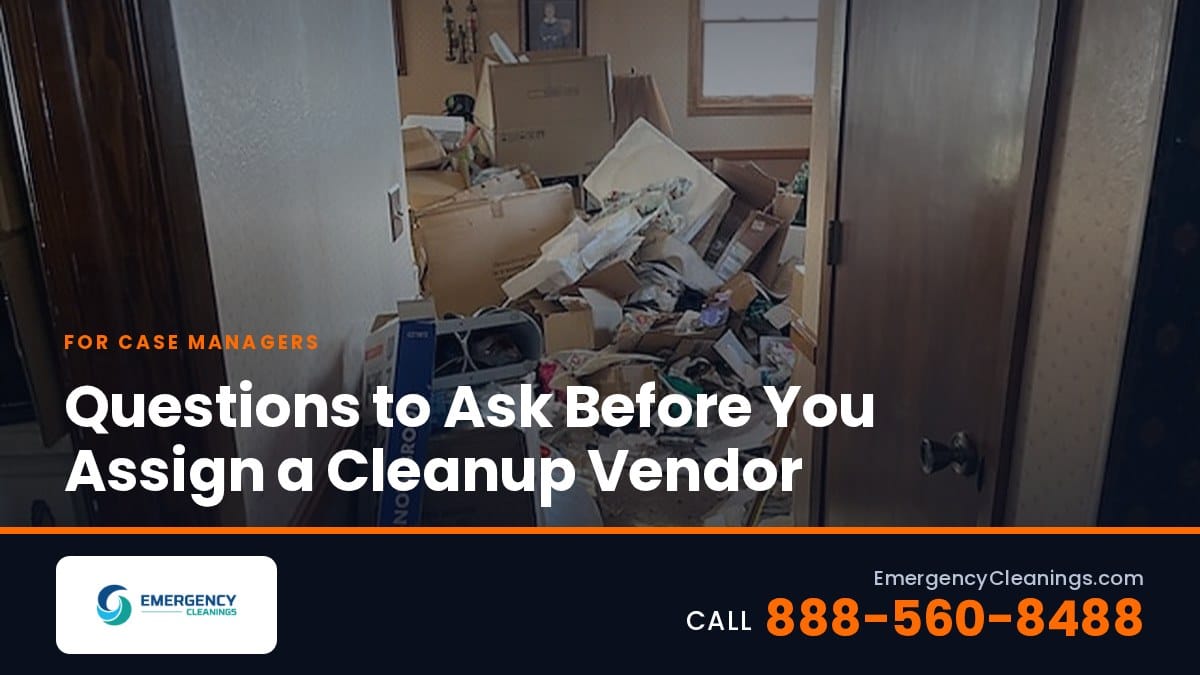
Before you assign a hoarding cleanup vendor, ask five things: how they get your client’s consent on what stays, what lands in your case file afterward, whether their invoice can clear your agency’s approval chain, how fast they can meet an inspection date, and how the crew is protected. Emergency Cleanings answers all of these in writing before any work starts, with a flat price your supervisor sees up front.
Your client has a code notice or a hearing coming up. Your supervisor will read the invoice, and an auditor may read it after that. Here is what to ask on the first call.
Will the crew treat your client as the one who decides?
A client who feels steamrolled stops cooperating, and a client who stops cooperating can lose the apartment anyway. Ask the vendor how they handle the keep and discard question in the room. You want a clear answer that the client, or the guardian with legal authority, makes the call on personal items, and that the crew asks before bagging anything that could matter.
Push for specifics. Do they set aside a keep zone before the first bag goes out? Do they stop when they find papers, cash or keys? Will they phase the home room by room if the client needs a slower pace?
If you serve as guardian or conservator, this piece carries extra weight. The National Guardianship Association’s Standards of Practice say a guardian should avoid even the appearance of a conflict of interest or impropriety, and should give family and friends a chance to claim items of sentimental value when a ward’s assets are disposed of. A vendor who photographs and lists what was kept, donated and discarded makes that record easy to produce.
The crew should stay out of diagnosis and treatment talk. Cleanup does not treat hoarding disorder. For clinical support and local task forces, the International OCD Foundation’s hoarding resource site keeps a searchable directory.
What comes back for the case file?
Ask to see a sample closeout package before you assign anything. At minimum it should hold dated before and after photos, the written scope the client or guardian approved, and an itemized invoice that matches that scope. Disposal records you can request should be available if a landlord, court or program asks where the material went.
Emergency Cleanings photographs the home during the free on-site walkthrough, then again when the work is done. The Project Coordinator calls with the exact price and a step-by-step plan, and that plan becomes the scope in your file. We cover the paperwork side in more depth in How Adult Protective Services Refers a Hoarding Cleanup, and Who Pays.
Can the invoice clear your approval chain?
This question decides more cases than any other, and every agency answers it differently. Rules vary by state and agency, and none of this is legal advice. Your purchasing office has the final word.
Texas is a useful example of how specific these limits get. The Texas APS handbook, section 3600, lists heavy cleaning among purchased client services. It requires supervisor approval for any purchase, a second level of approval above $750, and coordination with a DFPS contract manager before purchases over $5,000. Agency purchasing cards there cap at $3,000 per transaction and $3,000 per monthly billing cycle.
So ask for one flat price, set after a walkthrough and locked before work begins. Your supervisor then approves a number that will not grow. If the scope runs past your approval tier, route it up the chain. Splitting one job into smaller invoices to slip under a threshold is a procurement problem, and a careful vendor will refuse to do it.
Federal pass-through money has its own rules. Under 2 CFR 200.320(c), a noncompetitive award is allowed when a public exigency or emergency will not permit the delay of a competitive solicitation. The same section lets recipients self-certify a micro-purchase threshold up to $50,000.
Then ask about the paperwork your county needs to cut a check. That usually means a certificate of insurance naming the county as additional insured, a W-9, and a vendor record on file. Our post on getting on a county vendor list walks through that process from the vendor side.
How fast can they move when there is a date on the notice?
An inspection date does not move because a vendor is booked. Ask for the response window in plain terms. Emergency Cleanings offers same-day response, a two-hour arrival window, and a text with the technician’s ETA. Work often starts the same day the price is approved.
Also ask whether they will clean to the standard on the notice. If the code officer cited blocked exits, the crew opens the exits and the path to them first.
How is the crew protected on site?
Hoarded homes can hold sharps, blood, rodent waste and spoiled food. Ask whether the vendor’s employer follows the OSHA bloodborne pathogens standard, including a written exposure control plan and hepatitis B vaccination offered to exposed workers.
Expect accuracy here too. OSHA’s 2007 interpretation says urine and feces fall outside that standard’s definition of other potentially infectious materials unless visibly contaminated with blood. Surface mold gets cleaned as part of the work. Deep mold mitigation, water damage restoration, fire restoration, plumbing repair, and rebuilding are separate trades that Emergency Cleanings does not perform.
You can see how we scope these jobs on our hoarding cleanup service page.
Frequently Asked Questions
Who should approve what gets thrown away?
The client decides on personal items, or the guardian or conservator with legal authority over the property. The vendor should ask before discarding anything that could matter and photograph what was kept and removed.
Can a cleanup be split into phases to fit a budget cycle?
A job can be phased room by room at a fixed price per phase when that serves the client. Phasing should follow the work and the client’s pace, never an effort to keep invoices under an approval threshold.
What documents should a caseworker get at the end of the job?
Dated before and after photos, the approved written scope, an itemized invoice matching that scope, and disposal records you can request if a court or landlord asks.
Does the vendor need to be on a county vendor list first?
Most counties need a vendor record and insurance certificate on file before they can pay. Ask your fiscal office what they require and send the vendor that list on the first call.
If you have a client on a deadline, call Emergency Cleanings at 888-560-8488. We offer same-day response and a free on-site assessment, then send a written scope with one flat price locked before any work starts.