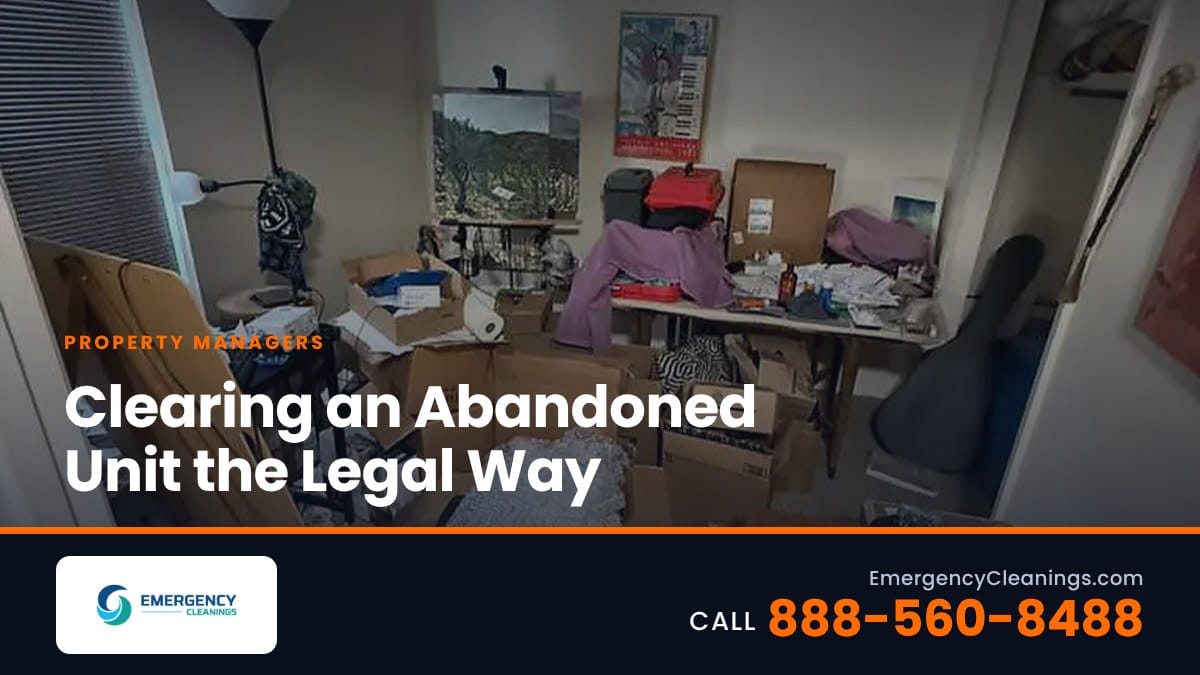

An adult protective services hoarding cleanup is a cleanout of a client’s home that a caseworker sets in motion after a self-neglect or unsanitary-conditions referral, done by an outside contractor under whatever authority the case carries: client consent, a code citation, a court appointment, or emergency protective action. It serves APS staff, code enforcement, guardians, and conservators who need the home made habitable and the work documented. Emergency Cleanings scopes on site and locks a flat price with the authorizing party before anyone starts.
If you work in adult protective services, aging services, or county code enforcement, you already know the shape of these cases. The referral says “unsanitary living conditions.” The reality is a house that has not been maintained in a decade, a client who does not want you there, and a budget line that does not obviously cover any of it.
This is a practical explainer on how these cleanups actually get referred, authorized, and paid for — written for the person holding the case file.
Hoarding sits inside self-neglect, and self-neglect is most of the caseload
In the federal National Adult Maltreatment Reporting System, hoarding is explicitly included in the definition of self-neglect. That matters because self-neglect is not a niche category. In an ACL analysis of NAMRS data for federal fiscal year 2022, clients with self-neglect allegations accounted for 54% of all APS clients across the 36 states reporting disposition data, though the share ranged from 20% to 88% state to state. Self-neglect also carried the highest substantiation rate of any maltreatment type, at 46%.
Translation for a vendor conversation: this is not an occasional referral type. It is the single largest thing APS does, and any contractor who treats it as an exotic edge case has not worked with agencies before.
The four ways these referrals reach a contractor
1. APS-initiated, client-consented
The most common and the least complicated. The caseworker has built enough rapport that the client agrees to work. The client is technically the customer even when the agency arranged it, and the client’s consent governs the scope. Contractors who do not understand this will overreach on day one and lose the client’s cooperation for good.
2. Code enforcement or housing authority abatement
A citation with a compliance deadline. The property owner is on the hook, and the work is defined by the citation’s language rather than by anyone’s judgment about what “clean” means. Ask for the citation itself before quoting — abating what was cited is a different job from cleaning the house.
3. Guardianship, conservatorship, or receivership
A court has appointed someone with authority over the person or the property. That person signs. Contractors should be asking to see the letters of appointment, not taking a caseworker’s word for who has authority, and a good one will.
4. Emergency protective action
Imminent risk — no heat, no working sanitation, an active infestation, a fire load that has drawn the fire marshal. These move on hours, not weeks, and generally under a different funding mechanism than routine work.
Who actually pays
There is no single national answer, and any contractor who claims otherwise is guessing. In practice the money comes from one of these:
- The client. More often than people assume. Many self-neglect clients have assets and simply have not been asked directly.
- APS emergency or discretionary funds. Usually capped, usually small, usually requiring multiple quotes and a purchase order. Ask your supervisor what the per-case cap is before you set expectations with a client.
- Area Agency on Aging or Older Americans Act funds, where the client meets age and need criteria.
- The property owner or landlord, when the citation runs to the property.
- The estate or the conservatorship, once a court has appointed someone to authorize it.
- Medicaid HCBS waivers in some states, where environmental modification or “environmental accessibility adaptation” services exist. This varies enormously by state and is worth a call to your state unit on aging.
Most cases end up braided — a partial payment from a program plus a client contribution. That is normal, and a contractor who cannot invoice against two sources is a contractor who has not done agency work.
What a caseworker should require from a vendor
- An on-site scope before any price. No phone quotes. A number quoted sight-unseen is a number that will change.
- A fixed, written price tied to a written scope, so your file has a defensible figure and your client is not exposed to an open meter.
- Written scope limits the client agreed to — which rooms, what is set aside, what is not touched.
- Before-and-after documentation in a form you can put in the case file or submit to a court.
- Bloodborne pathogen training and an exposure control plan where any biological contamination is present. This is an OSHA obligation on the contractor, not a nice-to-have.
- Proof of insurance and, where required, county vendor registration.
- A crew that has been trained not to shame the client. You will be back at that address. The contractor will not.
The thing that decides whether it holds
A single large cleanout, done to a resistant client, has a poor track record. The research on what does work points the other way: sustained, lower-intensity contact over time. Where the client is willing, phasing the work — and pairing it with whatever ongoing support your agency can attach — is the version that is still standing at the six-month check.
Contractors who only sell the one-day cleanout are selling you the version that fails. Ask whether they will work in phases.
Working with Emergency Cleanings
Emergency Cleanings works with caseworkers, guardians, receivers, and code enforcement. Our pricing is a flat fee: a technician scopes the property on site, we settle price and scope with the authorizing party before work begins, and the price does not move afterward — which is usually what a case file needs it to do. We document before and after, and we will work to a limited scope when limited scope is what the client consented to.
Frequently Asked Questions
How does a caseworker engage a hoarding cleanup vendor?
Call and describe the case, including who holds authority to authorize the work. A technician goes out for a free assessment, then Emergency Cleanings puts a written scope and a flat price in front of that party. Nothing starts until they sign off, and same-day response is available.
What documentation goes into the case file?
You get the written scope, the flat price tied to it, and before-and-after photo documentation you can file or submit to a court. Disposal records are available on request. Phased jobs carry a scope and price per phase.
What happens when the resident has capacity and refuses?
Then the resident decides. A client with capacity can consent to a limited scope, name rooms that stay untouched, and set aside items they want kept. The crew works inside those limits and is trained not to shame the resident, since you keep the relationship after the trucks leave.
How is the price set, and what work is not covered?
Price is a flat fee locked after the on-site scope, so the figure in your file is the figure at the end. Hoarding, junk-out, and biohazard work such as feces, urine, and sewage are covered. Mold, water damage, fire restoration, and plumbing are not.
To talk through a specific case, call Emergency Cleanings at 888-560-8488 for a same-day response. The assessment is free, a technician scopes the property on site, and the flat price is locked before any work begins. Our hoarding cleanup and biohazard and waste cleanup pages cover what the crews are equipped for.