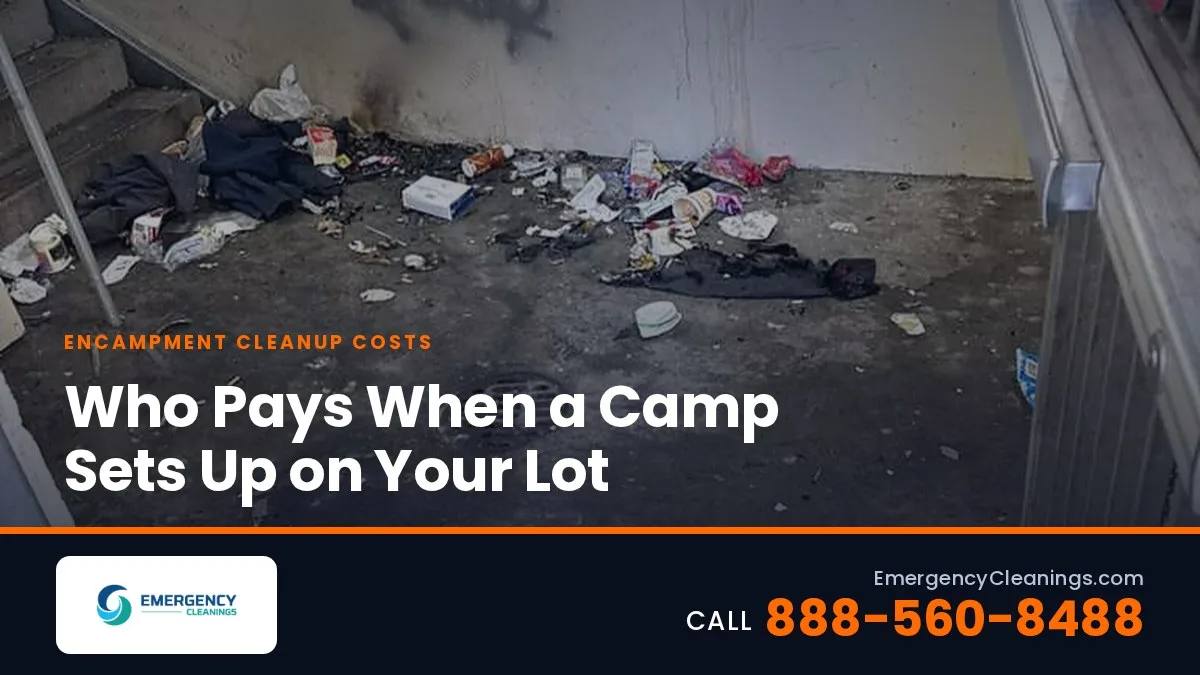
On private property, the owner pays for homeless encampment cleanup, and if the owner waits too long, a city can do the work and bill the parcel. On public land, the city or agency that controls the land pays. Emergency Cleanings prices each encampment cleanup as one flat fee set after a free on-site walkthrough, and the cost is driven by sharps, human waste, debris volume and site access.
You own the building. Maybe it’s a strip center with a loading dock around back, or a warehouse on a lot with a fence line nobody walks. One morning a tenant calls, or a broker texts a photo, and there are tents behind the dumpster enclosure. Now you have two questions at once. Whose problem is this, and what is it going to cost you?
Who Pays for Encampment Cleanup Depends on Whose Land It Is
The dividing line is ownership. If the camp sits on a sidewalk, a highway right of way or a city park, the public agency that controls that ground handles and funds the cleanup. If it sits on your parcel, inside your fence or against your wall, the cost is yours.
Government money for encampments mostly goes to people and services, and cleanup is often paid for separately. California is a good example. Its Encampment Resolution Funding program pays for outreach, housing navigation and shelter, and the state’s Legislative Analyst notes that grantees generally use non-ERF funds, such as local funds, for site restoration and cleanup. None of that money flows to a private owner clearing a back lot.
How the City Can End Up Sending You the Bill
Plenty of owners figure the city will eventually come clean it up, and some cities do, with the invoice mailed to the owner afterward.
Most cities have nuisance abatement ordinances. When debris, waste or an unsafe condition on private land is declared a nuisance and the owner does not fix it after notice, the city can hire the work out and recover the cost from the property. California law spells this out plainly. A city may by ordinance make the cost of abatement a special assessment against the parcel under Government Code 38773.5. Under Section 38773.1, a nuisance abatement lien is recorded with the county and carries the priority of a judgment lien.
A recorded lien on a building you are trying to lease or sell is its own kind of expense. It shows up in title work. Your buyer’s lender will see it. Paying your own crew on your own schedule tends to cost less than paying the city’s contractor plus administrative fees on the city’s schedule. Rules vary by state and city, and none of this is legal advice.
What Drives Homeless Encampment Cleanup Cost
No two sites price the same. Here is what moves the number up or down when a technician walks your lot.
Sharps
Used needles change everything about how a crew works. They slow the pace, because every pile gets searched by hand with tools before anyone grabs it. OSHA’s bloodborne pathogens standard requires contaminated sharps to go into containers that are closable, puncture resistant, leakproof on the sides and bottom, and labeled. A few syringes on pavement take far less time than needles mixed through bedding and soil.
Human Waste
Buckets, bags and soiled ground near a wall are common. Urine and feces are not treated as bloodborne pathogen material under OSHA’s rules unless they are visibly contaminated with blood. They still carry bacteria and viruses, so a crew wears protection, removes the waste, and disinfects the hard surfaces it touched. Concrete cleans up. Bare dirt sometimes has to be scraped and bagged.
Volume and Weight
Tents, tarps, mattresses, shopping carts, pallets and wet bedding add up fast. Wet material weighs far more than dry. The load count to the landfill or transfer station is a big part of any disposal line.
Access
A camp on flat pavement next to a drive aisle is easy to load. A camp down a drainage slope, under a bridge abutment or behind a fence with no gate means hand carrying everything. Access alone can double the labor on a job.
Damage Left Behind
Tapped electrical boxes, cut fencing, graffiti and burned patches all show up on walkthroughs. Surface mold gets cleaned as part of the work. Deep mold mitigation, water damage restoration, fire restoration, plumbing repair, and rebuilding are separate trades that Emergency Cleanings does not perform. Electrical and fence repairs go to your own vendors.
Belongings, the Courts, and Why You Should Not Rush the Dumpster
The people may be gone while their things still count as unabandoned in the eyes of the law.
Two court cases get quoted a lot, and both are about government action. In Lavan v. City of Los Angeles (9th Cir. 2012), the court held that the Fourth and Fourteenth Amendments protect homeless people from government seizure and summary destruction of unabandoned, momentarily unattended property. In City of Grants Pass v. Johnson (2024), the Supreme Court held that enforcing generally applicable laws regulating camping on public property does not violate the Eighth Amendment’s ban on cruel and unusual punishment. Grants Pass is about whether cities can enforce camping laws on public land. It does not tell a private owner how to handle what is left on a parcel.
A private owner is not a city, and those cases do not map directly onto your lot. Your state’s trespass and abandoned property laws do. The safe order of operations looks like this:
- Call the police non-emergency line to report trespassing, and let them handle anyone still on site.
- Post notice if your state or city requires it before removing personal property.
- Photograph everything before it moves.
- Set aside IDs, documents, medication and anything that looks valuable instead of throwing them out.
- Then clear the site.
Our earlier guide on homeless encampment cleanup on private property walks through the notice and trespass side in more detail.
How Emergency Cleanings Prices an Encampment Job
An encampment is usually a one-time problem, and Emergency Cleanings prices it as one job with no monthly service contract attached.
A technician arrives inside a 2-hour window, and you get a text with an ETA when they are on the way. They walk the whole site and photograph it. Then a Project Coordinator calls you with the exact final price and the step-by-step plan. That price is one flat fee covering labor, disposal, transportation, equipment and insurance. It is locked before any work begins, and work often starts the same day. You get photo documentation when the site is clear, and disposal records you can request. That file is useful if a city inspector, a buyer or your insurer asks what was done.
If squatters also got into a vacant suite, the post on commercial emergency cleaning for offices, retail and warehouses covers the inside of the building. For details on the encampment service itself, see our homeless encampment cleaning page.
Frequently Asked Questions
Who pays for homeless encampment cleanup on private property?
The property owner pays. If the owner does not act after a nuisance notice, many cities can abate the problem themselves and recover the cost through a lien or special assessment on the parcel.
Can the city put a lien on my property for encampment cleanup?
In many places, yes. California, for example, lets cities make abatement costs a special assessment against the parcel and record a nuisance abatement lien that carries the priority of a judgment lien. Rules vary by state and city.
Can I throw away belongings left at an encampment on my property?
Check your state and local rules first. Some places require notice or a holding period before personal property is removed. Photograph everything and set aside IDs, documents and medication before any cleanup starts.
What makes homeless encampment cleanup cost more?
Needles, human waste, heavy or wet debris, and hard access such as slopes or fenced areas without a gate raise the labor and disposal involved. Emergency Cleanings sets one flat price after a free on-site walkthrough, locked before work starts.
If you have tents on your lot or a mess left behind after a camp cleared out, call 888-560-8488. We offer same-day response and a free assessment on site, and you get a written scope with one flat price locked before any work starts.