Commercial emergency cleaning is the decontamination and removal work a property owner needs after a biohazard, human waste, sewage, chemical, or abandoned-tenant incident in an office, retail, or warehouse space. It covers the contaminated area and the regulated waste that leaves it, plus the paperwork an insurer or lease file will ask for later. Emergency Cleanings dispatches vetted, licensed, insured local technicians nationwide, scopes the site in person, and locks a flat price before any work starts.
The call almost never comes from your tenant. It comes from a broker who walked a vacant suite, a maintenance vendor who opened a stairwell door, or a police officer standing in your parking lot at 6 a.m. Something is in your building — a decedent found days late in a suite you thought was subleased, human waste stacked in a recessed entryway, a sewage line that let go into a retail bay, a chemical drum a departing tenant left tipped on a warehouse slab. You are the owner. There is no facilities director between you and this.
What you are managing is not a mess. It is a re-lease date, an insurance file, and an exposure. This guide maps what falls under commercial emergency cleaning for an owner: the incident categories, what each really involves, who carries the liability, what paper you need to come out of it clean, and how to tell a remediation contractor from a janitorial company about to take a job it has no business taking.
The six incident categories an owner actually encounters
1. Biohazard and after-death scenes
An unattended death in a leased suite, a suicide in a stairwell, an assault in a garage. Blood and decomposition fluids do not stay on the surface — they travel into subfloor seams, wick into drywall bottom plates, and load the HVAC return with odor. Scope is decontamination and removal, not cleaning: porous material within the contaminated field comes out, non-porous surfaces are cleaned and disinfected, and the affected waste leaves as regulated waste.
This is the category where contractor qualification is not optional. OSHA has stated plainly that its Bloodborne Pathogens standard reaches this work: in a May 22, 2007 letter of interpretation, OSHA confirmed the standard applies to crime scene and trauma cleanup contractors, that dried blood is still covered (“the standard is concerned about exposure to blood regardless of how long it has been exposed to air”), and that resulting waste is regulated waste requiring closable, leak-proof, labeled or color-coded containment. If a vendor cannot describe their exposure control plan, they are not qualified for after-death cleaning.
2. Human waste and encampment residue
Doorways, loading docks, stairwells, elevator lobbies, the back corner of a surface lot. For most owners this is the highest-frequency category by a wide margin, and the one most likely to be handed to a porter with a mop and a bottle of bleach.
Here is the detail almost every vendor gets wrong, and it cuts both ways. OSHA’s Bloodborne Pathogens standard, 29 CFR 1910.1030, does not automatically cover feces and urine. In a July 30, 2007 interpretation, OSHA stated that “urine, feces, and other reasonably anticipated biological components comprising human wastes in sewage are not included in the definition of ‘other potentially infectious materials’ unless… visibly contaminated with blood.” So a vendor claiming that federal bloodborne pathogen rules govern every urine cleanup is overselling. But encampment residue is rarely clean waste — it comes with discarded needles, and needles are covered, and blood-contaminated material is covered. The real hazard profile is what is mixed in.
The public health stakes are documented. CDC reported in MMWR (November 2, 2018) that hepatitis A outbreaks associated with drug use and homelessness in just four states produced 1,521 acute infections, with 1,073 (70%) hospitalized and 41 deaths. That is the reason feces cleanup and encampment cleaning are decontamination scopes with sharps handling and disinfection, not pressure washing.
3. Vandalism and squatter aftermath
A vacant floor that has been occupied without your knowledge produces a specific signature: soiled bedding, drug paraphernalia and sharps, human waste in non-functioning restrooms or in corners, food waste and pest activity, and often stripped copper. The cleanup itself is straightforward once it is scoped correctly; what owners get wrong is sending a leasing agent or a general contractor’s laborers in first. Sharps in soft material are how people get stuck. Get a needle sweep done before anyone else enters, then clear and decontaminate.
4. Sewage backup
A failed lateral, a lift station outage, or a blocked main pushes sanitary sewage into a retail bay, a basement, or a warehouse floor. Be precise about what you are buying: this is sewage cleanup — extraction of contaminated material, removal of affected porous building materials, and disinfection of the space — not water damage restoration. They are different scopes sold by different trades, and conflating them is how an owner ends up with a dried-out room that still has contaminated substrate under the base.
On the regulatory side, do not let a vendor invoice you for bloodborne pathogen protocols on a plain sewage loss. OSHA said in a September 13, 2005 letter that it “does not generally consider the contact with diluted raw sewage or waste water… to be related to bloodborne pathogens,” while still requiring the employer to assess the specific workplace and supply appropriate PPE. Sewage is a genuine pathogen exposure. It is just governed by hazard assessment and PPE, not by a checkbox.
5. Chemical or oil release
Warehouse and flex tenants leave drums, totes, hydraulic reservoirs and floor-scrubber chemistry behind. A forklift punctures a container, a transformer or compressor sheds oil, a departing tenant abandons unlabeled product in a back bay. This is the category with the shortest legal fuse, because the owner’s obligation can start before any cleaning does.
- Oil reaching water. Under EPA’s discharge of oil regulation, the trigger is a discharge that causes “a film or sheen upon or discoloration of the surface of the water or adjoining shorelines.” 40 CFR 110.6 requires the person in charge of the facility to “immediately notify the National Response Center.” A storm drain in your parking lot is a pathway to water.
- Listed hazardous substances. 40 CFR 302.6 requires immediate notice to the same National Response Center for a release equal to or exceeding the substance’s reportable quantity in any 24-hour period.
- Who may respond. Emergency response to an uncontrolled hazardous substance release sits under OSHA’s HAZWOPER standard, 29 CFR 1910.120(q), which requires responders to be trained to a defined level before they participate.
Confirm reporting status first, then scope the chemical and oil spill cleanup. Larger production and warehouse scopes fall under industrial cleanup.
6. Abandoned-tenant cleanout
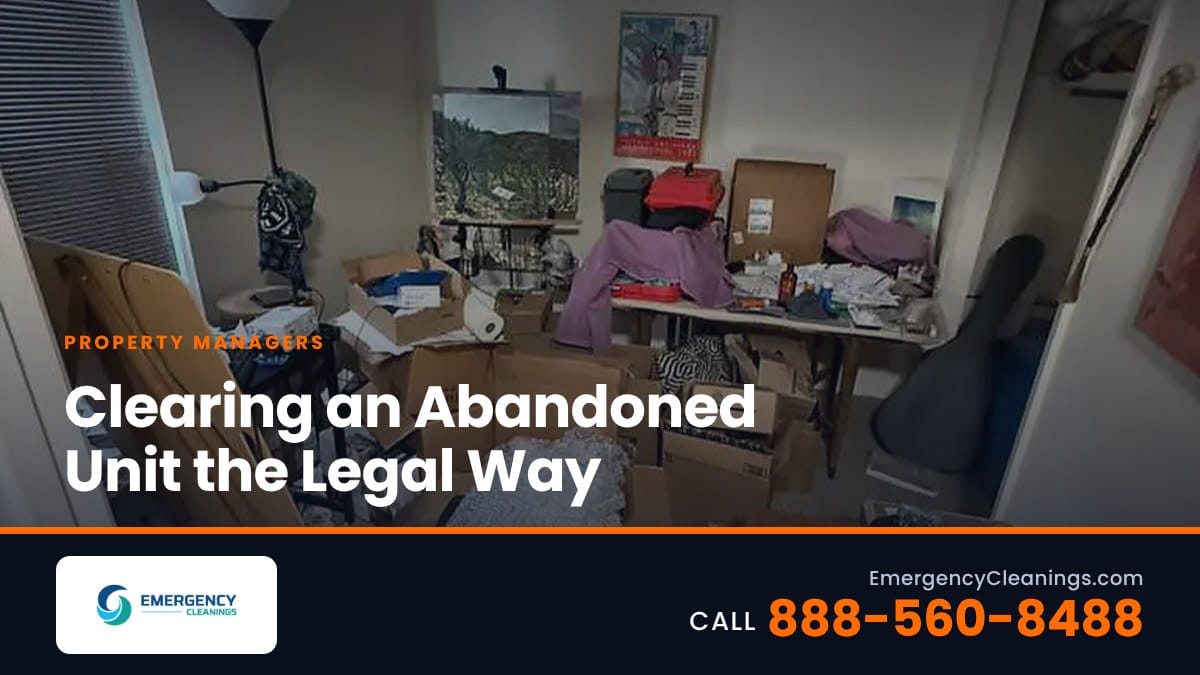
A tenant defaults, walks, or dies mid-term and leaves the space loaded. This is a legal sequence before it is a cleaning sequence: commercial landlord-tenant statutes vary by state on when property is deemed abandoned, what notice is required, and what you may remove or dispose of. Confirm your position with counsel before anything moves. Once you have authority, treat the contents as three separate problems — records and property that must be preserved, contaminated material that requires a decontamination scope, and everything else — and get the space to a condition a broker can show.
Who carries the liability
Three questions decide it, in order.
- Where did it happen? Common areas, exterior, roof, structure and building systems generally sit with the owner. Inside the demised premises the lease controls, and in most net leases the tenant carries it — until the tenant is gone, insolvent, or deceased, at which point it returns to you regardless of what the lease says.
- Who has notice? Once you know a hazard exists on your property, the clock on your premises-liability exposure starts. Documented delay is the single most damaging fact in a later claim.
- What does the policy actually cover? Read the pollution and contamination exclusions before you assume. Many owners find biohazard decontamination and abandoned-property cleanout are treated very differently by the same policy.
One durable point: disposal of the resulting waste is regulated primarily at the state level. EPA notes it “has not had authority, specifically for medical waste, since the Medical Waste Tracking Act (MWTA) of 1988 expired in 1991,” leaving states to regulate it. Your contractor’s disposal path has to be legal in your state, and you want proof of it in your file.
The documentation an owner needs
Assume every emergency cleanup will be re-examined later by an adjuster, a court, a lender in diligence, or the next tenant’s attorney. Require:
- Dated, geotagged photo documentation before, during and after, keyed to a floor plan or unit number.
- A written scope of work stating exactly what was decontaminated, what was removed, and what was intentionally left — with the boundary of the contaminated field described.
- Disposal documentation for regulated waste showing the licensed facility that received it.
- Proof of the crew’s qualification — bloodborne pathogen training records and an exposure control plan for biohazard work; HAZWOPER documentation for a hazardous substance release.
- Certificates of insurance naming the ownership entity, plus the vendor’s pollution liability coverage where the incident involves contamination.
- An incident timeline — when you were notified, when you dispatched, when the site was secured. This is what defends a notice question later.
- A final invoice that matches the scope, so the lease file, the claim file and the accounting all reconcile.
Telling a remediation contractor from a janitorial company
Janitorial companies will take this work, sometimes because they do not know what it is. Five questions sort it out fast.
- “What is in your exposure control plan, and when did you last update it?” A qualified biohazard contractor answers immediately, because 29 CFR 1910.1030 requires a written plan, annual review, training at no cost to the employee, and hepatitis B vaccination made available within 10 working days of initial assignment. A janitorial company will ask what you mean.
- “Where does the regulated waste go, and can I have the paperwork?” If the answer involves a dumpster on site, end the conversation.
- “Are you registered where registration is required?” Several states license this specifically. California, for example, requires anyone handling trauma scene waste to register with the state — Health and Safety Code section 118321.1 states that “a trauma scene waste management practitioner shall register with the department.”
- “What is your HAZWOPER level for a chemical release?” If they cannot name one, they are not responding to a release.
- “Will you scope on site and give me a fixed number before you start?” A phone quote on a job nobody has seen is a number that will change.
Working with Emergency Cleanings
We handle emergency cleanup, biohazard and after-death decontamination, human waste and encampment residue, squatter and vandalism aftermath, sewage cleanup, chemical and oil release response, and industrial and abandoned-tenant cleanouts for commercial owners.
Pricing is a flat fee. A technician scopes the property on site, we agree the price and the scope with you before work begins, and the price does not move afterward — no hourly meter, no revised number once crews are on the floor. You get the photo documentation, the written scope, and the disposal record your insurer and your lease file need.
Frequently Asked Questions
How fast can a commercial emergency cleaning crew arrive?
Same day in most markets. Emergency Cleanings works through a nationwide network of local technicians, so the crew comes from your area rather than driving in from another state. Call, describe the incident and the building, and a technician is dispatched to scope the site in person.
What does commercial emergency cleaning include, and what does it not?
Biohazard and after-death decontamination, human waste and encampment residue, squatter aftermath, sewage cleanup, chemical and oil releases, and abandoned-tenant cleanouts all fall inside the scope. Surface mold cleaning is included. Deep mold mitigation, water damage restoration, fire restoration, and plumbing repair are not. When a sewage loss also needs a pipe fixed or a wall dried out, that part goes to a separate trade.
How is commercial emergency cleaning priced?
As a flat fee. A technician walks the site, defines the contaminated field and what has to come out, and puts a single number in writing. That number is locked before work begins and does not change once the crew is on the floor.
Can my janitorial or maintenance staff handle this instead?
Not for biohazard, sharps, sewage, or chemical releases. Those scopes carry exposure and disposal requirements that porters are not trained or equipped for, and sending them in first is how someone gets stuck by a needle. Keep staff out, secure the area, and bring in a crew that can document the work.
Call 888-560-8488 for a same-day response. The assessment is free. A technician scopes the property on site and Emergency Cleanings locks a flat price before any work begins, so you hold one fixed number before anyone touches the space.