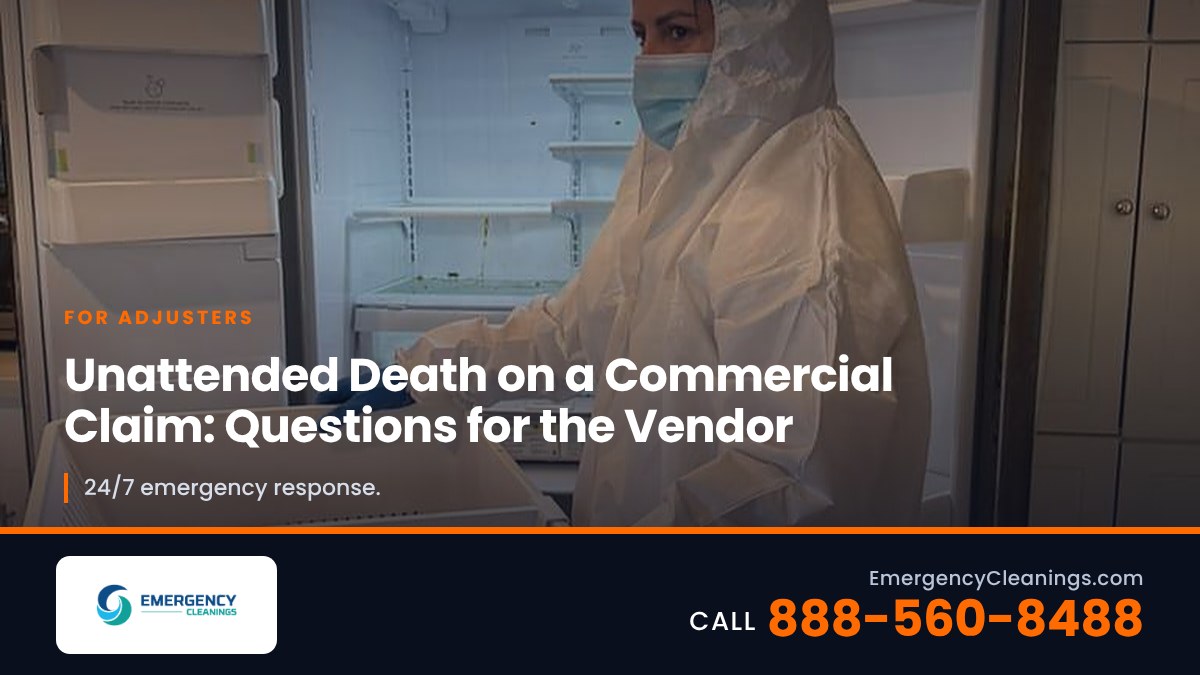
On an unattended death cleanup commercial claim, ask the vendor how fast a crew can be on site, how the scope is photographed and written, what porous material comes out, and where the regulated waste goes under your state’s rules. Emergency Cleanings answers those questions before work starts, with a free on-site assessment and one flat price agreed in writing.
The first notice usually arrives a day or more after the death. A hotel guest went unanswered through checkout, or a tenant in a flex warehouse stopped showing up. By the time the medical examiner releases the space, fluids have reached the carpet pad and the subfloor, and the insured wants to know when the room or suite reopens.
Here are the questions worth putting to the cleanup vendor on the first call.
Unattended Death Cleanup on a Commercial Claim: Start With Response Time
Business interruption starts accruing the day the space closes. A hotel room pulled from inventory or a retail floor taped off can add to the business interruption loss, subject to the policy’s waiting period. Ask:
- How soon can a technician be on site to assess, and how soon after approval can the crew start?
- Can the work run after hours so the rest of the building stays open?
- Who is your single contact for updates through the job?
Ask for a stated window and note it in the file.
How Is the Scope Documented?
Your scope has to hold up when someone reviews the file later. The vendor should photograph before anything is touched, then again as materials come out, and again at completion. Ask whether the written scope names each affected area and material by room, and whether the final invoice tracks that scope line for line.
Supplements usually start when the scope was vague on day one. If the vendor finds fluid migration under flooring after the first cut, you want photos of it and a call before they keep going. Our guide to the cleanup job file adjusters want to see lays out what a complete package looks like.
What Porous Material Comes Out, and What Gets Disinfected?
Decomposition fluids soak into anything porous. On a commercial loss that often means carpet and pad, upholstered furniture, ceiling tile, drywall at the base of the wall and sometimes the subfloor.
OSHA’s Bloodborne Pathogens Standard, 29 CFR 1910.1030, applies to all occupational exposure to blood or other potentially infectious materials. It requires that contaminated work surfaces be decontaminated with an appropriate disinfectant. That covers the vendor’s own employees doing the work. Ask the vendor:
- How do you decide what gets removed versus cleaned in place?
- How do you confirm contamination has been fully removed before the area is released?
- What disinfectant do you use, and is it appropriate for the surfaces in this space?
- How do you treat odor once the source material is out?
Keep the line clear on structural work. If the subfloor has to be cut out and replaced, the cleanup vendor removes the contaminated section and the rebuild goes to another trade.
Where Does the Regulated Waste Go?
This is the question many vendors answer loosely. The EPA states that medical waste is primarily regulated by state environmental and health departments, so the rules change at the state line. OSHA’s standard also requires regulated waste to be disposed of in accordance with applicable regulations, which includes the rules of the state where the loss sits.
Some states register the people who do this work. California, for example, requires anyone who removes blood and body fluids from a death scene as a commercial activity to register with the California Department of Public Health and show a contract with a registered transporter or permitted facility. Ask:
- What does your state require for trauma scene waste, and how do you meet it on this loss?
- Who transports the waste and where is it treated?
- What disposal records can I request for the claim file?
How Will You Work Beside the Restoration GC?
On larger files a restoration contractor may already hold the claim. The cleanup vendor’s job is the biohazard portion: removal of contaminated materials, disinfection, odor control and waste disposal. Rebuild work such as flooring and drywall replacement belongs to other trades.
Ask the vendor to confirm in writing where their scope stops so the GC’s estimate picks up cleanly. Two contractors pricing the same drywall is how leakage gets into a file. Emergency Cleanings does cleanup only, which makes the handoff to the GC simple to define.
When Can the Space Go Back Into Service?
Ask what the vendor needs before they release the area, and what the insured will see at handoff. A hotel room with a small affected area on hard flooring can turn over quickly. A warehouse office where fluids went through the subfloor waits on the rebuild trade after cleanup is done.
Get a realistic sequence from the vendor on the first visit. That sequence is what you’ll use to estimate the business interruption period and set the insured’s expectations.
Frequently Asked Questions
Does OSHA’s Bloodborne Pathogens Standard apply to after-death cleanup?
The standard, 29 CFR 1910.1030, applies to all occupational exposure to blood or other potentially infectious materials. It governs how the cleanup vendor protects its own employees, including decontaminating contaminated surfaces with an appropriate disinfectant.
Who regulates the disposal of biohazard waste from a death scene?
The EPA says medical waste is primarily regulated by state environmental and health departments. Rules differ by state, and some states, including California, require trauma scene cleanup practitioners to register.
What documentation should the cleanup vendor provide for the claim?
Ask for photos taken before and after the work, a written scope by room and material, an invoice that matches the scope, and disposal records you can request for the file.
Does Emergency Cleanings rebuild after the cleanup?
No. Emergency Cleanings handles the cleanup, including removal of contaminated porous materials and disinfection. Rebuild work such as drywall and flooring goes to the restoration contractor or other trades.
Get the Space Scoped and Back in Service
Call 888-560-8488 once the scene is released. We offer same-day response and a free on-site assessment. A technician photographs and scopes the loss, and a project coordinator calls with one flat price locked before work starts. See our after-death cleaning service for what the crew handles.