OSHA expects combustible dust cleaning to keep settled dust from building up on floors, beams, ductwork and any other surface where it could feed a fire or explosion, and its inspectors cite that duty under the housekeeping standard at 1910.22 and the General Duty Clause. A common rule of thumb treats a layer around 1/32 inch thick over more than 5% of a room’s floor area as a hazard. When the dust sits overhead or needs an outage to reach, Emergency Cleanings can send a vetted local industrial crew at one flat price locked before work starts.
Maybe an auditor ran a finger along a beam. Maybe your insurer’s loss control visit left a note, or a citation is already sitting on your desk. Now you own a dust problem with a deadline, and production did not slow down to help. Here is what OSHA looks for and how to build a cleaning plan you can defend.
What Counts as Combustible Dust
OSHA’s combustible dust page puts it plainly: “Any combustible material can burn rapidly when in a finely divided form.” Suspend that dust in air at the right concentration and it can explode. Metals like aluminum and iron qualify too, even though a solid block of either will not burn.
OSHA’s examples include:
- Food and agriculture: sugar, flour, starch, spice, candy, feed and grain
- Wood, paper and pulp
- Plastics and rubber
- Metals: aluminum, chromium, iron, magnesium and zinc
- Chemical and pharmaceutical powders
Why Accumulation Is the Hazard
A small event inside a dust collector is bad. The dust lying on surfaces around it is what makes it a disaster. OSHA’s Hazard Communication Guidance for Combustible Dusts explains that the first blast shakes settled dust loose, and that “this additional airborne dust, if ignited, may cause one or more secondary explosions.”
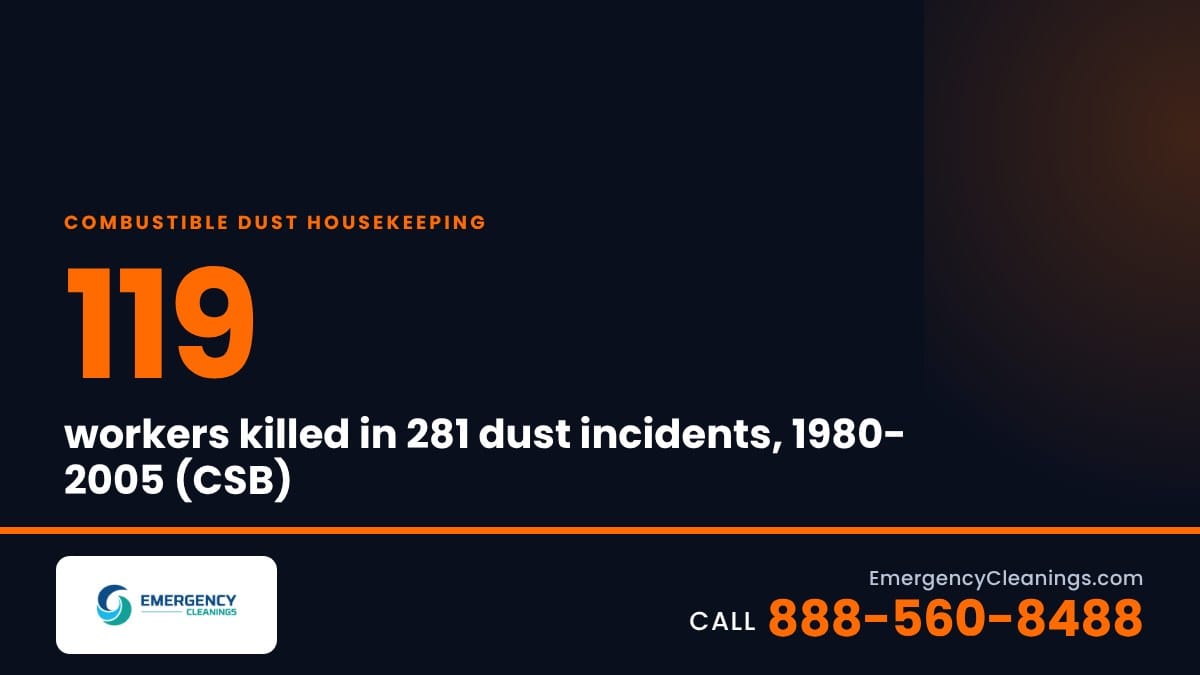
The U.S. Chemical Safety Board looked at this nationally. Its 2006 study found 281 combustible dust incidents between 1980 and 2005 that killed 119 workers and injured 718.
What OSHA’s Combustible Dust National Emphasis Program Covers
The current OSHA program is the Revised Combustible Dust National Emphasis Program, CPL 03-00-008, dated January 30, 2023.
The 2023 revision consolidated the targeted industry lists into one appendix and added six NAICS codes, commercial bakeries and grain wholesalers among them. It also clarified that the program can apply at facilities covered by the process safety management standard. If your NAICS code is on the list, plan as though an inspector will eventually walk your floor with a camera on an extension pole. The directive tells them they can do exactly that to photograph elevated areas.
The 1/32-Inch Rule of Thumb and Where It Comes From
You will hear “1/32 inch” from consultants and insurers. The figure traces back to NFPA 654, the National Fire Protection Association standard for combustible particulate solids. OSHA explained its enforcement use in a 2015 memo, Evaluating Hazardous Levels of Accumulation Depth for Combustible Dusts.
The short version:
- The 1/32-inch thickness assumes a uniform dust layer with a bulk density of 75 pounds per cubic foot.
- Under NFPA 654, a hazard exists when dust deeper than that layer depth covers more than 5% of the floor area, or more than 1,000 square feet in a single accumulation.
- Lighter dusts can sit deeper before they hit the same hazard level, so inspectors are told to account for bulk density.
- When accumulations are documented above 1 inch, inspectors do not need to send samples to OSHA’s lab for bulk density testing and can use approximate bulk densities from the employer or published sources.
If you can write your name in the dust across a big share of the room, assume you have a problem. NFPA 652, the fundamentals standard, sits beside NFPA 654 and calls for a dust hazard analysis. That analysis belongs with your engineer. A cleaning crew carries out the housekeeping that comes out of it.
How OSHA Cites Dust Housekeeping
There is no single federal combustible dust standard. Inspectors use existing rules instead, and housekeeping is the one most plant managers meet first.
The Housekeeping Standard, 1910.22
Under 29 CFR 1910.22(a)(1), places of employment and walking-working surfaces must be “kept in a clean, orderly, and sanitary condition.” Section (a)(2) adds that each workroom floor must be kept clean. The NEP directs inspectors to cite (a)(1) when the depth and extent of dust can present a fire or explosion hazard, and it names dust on top of equipment, structural members and ductwork. Floor accumulations fall under (a)(2). The directive also says small accumulations in isolated spots are not normally a violation.
The General Duty Clause
When no specific standard fits, OSHA can cite Section 5(a)(1) of the OSH Act, which requires employers to keep the workplace free from recognized hazards likely to cause death or serious physical harm. The NEP tells inspectors to document every element of that kind of citation. Where they cannot, the directive allows a Hazard Alert Letter instead.
Cleaning Methods That Don’t Make It Worse
OSHA’s 2005 safety bulletin on combustible dust says to “Use cleaning methods that do not generate dust clouds, if ignition sources are present” and to “Only use vacuum cleaners approved for dust collection.”
Vacuums Rated for the Job
A shop vac is not a combustible dust vacuum. The NEP lists conditions for portable vacuums used on combustible dust in unclassified areas, including conductive or static-dissipative hoses, bonded and grounded components, and a design where dust-laden air does not pass through the fan or blower. In classified hazardous locations, the equipment has to be suited to that classification.
Compressed Air Blowdown
Blowing dust off beams is fast and risky. Per the 2023 directive, compressed air or other high-energy methods may be used on some dusts only when the right safeguards are in place. In practice, most plants vacuum or sweep first and treat blowdown as a last step for spots nothing else can reach, with ignition sources controlled and equipment shut down per your own procedures.
Wet Methods
The NEP lists water wash-down alongside vacuuming and sweeping as acceptable ways to remove accumulated dust. Check compatibility first, since some metal dusts react with water.
The Hidden Areas Inspectors Check
The floor is the easy part. The NEP tells inspectors to check structural members, pipe racks, cable trays and areas above suspended ceilings, and to sample elevated surfaces like roof beams and the tops of ductwork.
Above-ceiling dust has a history. OSHA’s hazard communication guidance points to a 2003 explosion in Kinston, North Carolina, that followed a “buildup of dust above suspended ceilings.”
Walk your building with a lift and a flashlight and check:
- Roof trusses, purlins and open web joists
- Tops of ductwork, pipes and cable trays
- Light fixtures and unit heaters
- The space above drop ceilings in offices next to production
- Behind and under equipment that never moves
What the Imperial Sugar Investigation Found
On February 7, 2008, the Imperial Sugar refinery in Port Wentworth, Georgia, exploded. The Chemical Safety Board reports that 14 workers died and 38 were injured, and that the blasts were fueled by “massive accumulations of combustible sugar dust throughout the packaging building.” Its final report, released in 2009, was titled “Inadequate Equipment Design, Maintenance, and Housekeeping Led to Massive Sugar Dust Explosions.” The Board recommended a company-wide housekeeping program to keep dust off overhead surfaces and floors.
Overhead surfaces come first in that recommendation.
Building a Housekeeping Schedule
OSHA does not hand you a frequency. Its bulletin says to inspect for dust “in open and hidden areas, at regular intervals” and to clean at regular intervals too. Your schedule has to fit your own dust rate:
- Map the zones. Split the building into floor zones and elevated zones.
- Measure the buildup rate. Clean a zone, then check depth daily or weekly until you know how fast it returns.
- Set a trigger depth. Pick a cleaning trigger well below the hazard level, so you clean before you get close.
- Assign owners by shift. Floors and equipment usually stay with operators. Elevated surfaces often need a lift and a planned outage.
- Document it. Dated checklists and photos are what you show an inspector or your insurer.
- Fix the source. Leaking transfer points refill a clean room fast.
When an Outside Crew Makes Sense
Your team can handle daily floor cleaning. Outside help pays off here:
- Scheduled outages. High work goes faster with a dedicated crew and lifts while the line is down.
- High and hidden areas. Trusses, duct tops and above-ceiling spaces take people and equipment your maintenance staff may not have free.
- After a finding. A citation, a Hazard Alert Letter or an insurer recommendation usually comes with an abatement date.
- Baseline cleans. Get the building to zero once, so your in-house schedule starts from a known point.
Emergency Cleanings coordinates vetted local industrial crews nationwide. A technician walks the site and photographs every zone. Then a Project Coordinator calls with the exact final price and the plan, and that price covers labor, disposal, transport, equipment and insurance. It does not change once the final scope is set, which makes the PO simple. Work can be phased by area at a fixed price per phase to fit outage windows or budget years. You get photo documentation and disposal records you can request for your file. Settle prequalification and lockout/tagout paperwork before mobilization. See the industrial cleanups page for what the service covers, and the spill cleanup page if a process upset is part of the picture.
Frequently Asked Questions
What does OSHA require for combustible dust cleaning?
There is no single federal combustible dust standard. OSHA cites dust housekeeping under 29 CFR 1910.22 when accumulations on floors, equipment, structural members or ductwork could cause a fire or explosion, and it can use the General Duty Clause for recognized hazards.
Is 1/32 inch of dust an OSHA limit?
It is a guideline drawn from NFPA 654 that OSHA uses in enforcement. An OSHA 2015 memo explains that the figure assumes a bulk density of 75 pounds per cubic foot and a hazard when that depth covers more than 5% of the floor area, so lighter dusts can sit deeper before reaching the same hazard level.
Can we use compressed air to clean combustible dust?
OSHA’s 2023 Combustible Dust National Emphasis Program allows compressed air on some dusts only with appropriate safeguards in place. Vacuums designed for combustible dust, sweeping and water wash-down are listed as acceptable methods, and most plants use them first.
Where do inspectors look for hidden dust?
The National Emphasis Program directs inspectors to check horizontal structural members, pipe racks, cable trays, areas above suspended ceilings, and elevated surfaces such as roof beams and the tops of pipes and ductwork.
Can an outside crew clean during our scheduled outage?
Yes. Emergency Cleanings can scope the work ahead of your outage and phase it by area at a fixed price per phase, so the crew works the window you already have on the calendar.
Get Your Dust Cleanup Scoped Before the Next Outage
If you have a finding to abate or overhead dust nobody has touched in years, call 888-560-8488. We offer same-day response and a free on-site assessment, and you get a written scope with one flat price locked before any work starts.