A chemical spill response plan for a small facility sorts every likely spill into one of two buckets: incidental releases your own trained people can absorb and control, and emergency releases that send everyone out while outside responders take over. It ties that split to OSHA’s HAZWOPER and Emergency Action Plan rules, and to EPA’s SPCC rule if you store enough oil. Emergency Cleanings fits in after the release is controlled, handling cleanup, decontamination and removal at one flat price.
You run a small plant with a few drums of cutting fluid and a corrosives cage out back. An auditor wrote you up, or a forklift punctured a tote last month and nobody knew who was supposed to do what. Now you need a plan that holds up on paper and that your crew will follow at 2 a.m.
Start With the Line OSHA Draws: Incidental Release or Emergency
Everything in your chemical spill response plan hangs on one distinction from the HAZWOPER standard, 29 CFR 1910.120. OSHA defines emergency response as a response by employees from outside the immediate release area, or by outside responders, to a release that is or is likely to become uncontrolled. The same definition says that responses to incidental releases that can be absorbed, neutralized or otherwise controlled at the time of release by employees in the immediate area are not emergency responses under the standard.
OSHA has described an incidental release as one that does not cause an imminent health or safety hazard to employees and does not have to be cleaned up immediately to prevent death or serious injury. The agency tells employers to judge case by case, looking at the size of the spill, the material and where it happened. People cleaning up incidental spills still need proper equipment and Hazard Communication training.
If you expect your people to stay and fight an uncontrolled release, you take on the full emergency response requirements of paragraph (q), with a written emergency response plan and much heavier training.
The Evacuate-Only Path
Most small facilities choose the evacuate-only path. HAZWOPER paragraph (q)(1) says employers who evacuate employees from the danger area and do not let any of them help handle the emergency are exempt from that paragraph if they provide an emergency action plan complying with 29 CFR 1910.38. OSHA’s own inspection directive for paragraph (q) says employees handling only incidental releases are expected to evacuate if the release escalates beyond incidental. Your crew needs enough training to tell the two apart.
Build the Emergency Action Plan Under 1910.38
Your Emergency Action Plan is the backbone. Under 29 CFR 1910.38, it has to be in writing, kept in the workplace and available for employees to review. A shop with 10 or fewer employees may communicate it orally.
The minimum elements are:
- Procedures for reporting a fire or other emergency
- Evacuation procedures, including type of evacuation and exit route assignments
- Procedures for employees who stay to run critical operations before they evacuate
- Procedures to account for all employees after evacuation
- Procedures for employees performing rescue or medical duties
- Names or job titles of the people to contact for more information about the plan
The standard also requires an employee alarm system with distinctive signals, and it requires you to designate and train employees to help with a safe, orderly evacuation. You review the plan with each employee when the plan is first written, when their responsibilities change and whenever the plan changes.
Add the Spill-Specific Pieces
An EAP covers getting people out. A chemical spill response plan adds what happens at the spill itself. Build these sections on top.
1. A Chemical Inventory Tied to Locations
List each hazardous chemical, the largest container size and where it sits. Pull the Safety Data Sheet for each one and note the spill section. A gallon of mineral oil on sealed concrete and a gallon of concentrated acid near a floor drain are two very different events.
2. Your Incidental Threshold, Written Down
For each chemical or area, write what your crew may handle on its own. Something like: up to one drum of cutting fluid on the shop floor, contained with pads and socks, by employees trained on that product. Past that line, or with any unknown material, any injury or any vapor, the crew evacuates and calls for outside help.
3. Spill Kits That Match the Chemicals
Universal absorbents, acid and caustic neutralizers, drain covers and the PPE the SDS calls for. Put kits where spills are likely. Assign someone to restock after every use.
4. Drain and Containment Map
Mark every floor drain, storm drain and door threshold that could carry a spill outside.
5. Notification Tree
Write down who calls 911, the plant manager and your environmental contact. Some spills also have to be reported to government agencies. The National Response Center at 800-424-8802 takes reports of oil, chemical and other discharges into the environment anywhere in the United States. Reporting thresholds depend on the substance, and states add their own rules, so confirm yours with your environmental consultant or state agency and print the numbers in the plan.
6. Post-Spill Cleanup and Waste
Used absorbents, contaminated soil and rinse water have to go somewhere legal. Name who handles disposal and how you keep the records.
When EPA’s SPCC Rule Joins the Picture
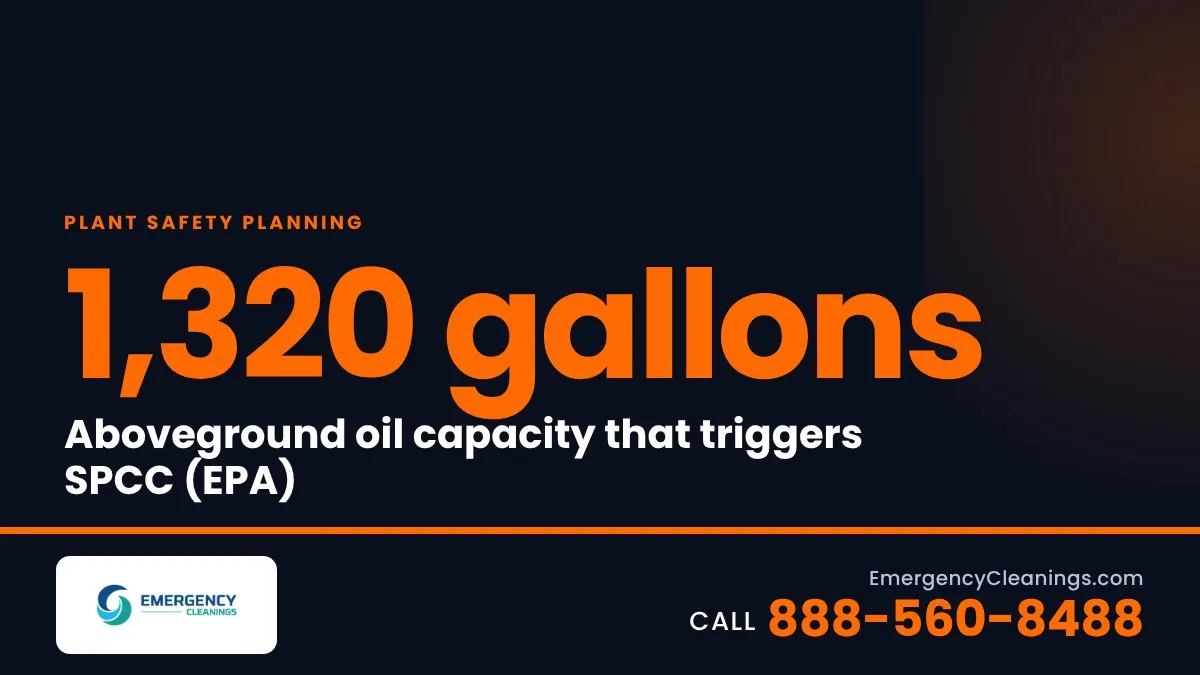
If your site stores oil, check the Spill Prevention, Control, and Countermeasure rule at 40 CFR Part 112. It applies to non-transportation facilities with aggregate aboveground oil storage capacity greater than 1,320 gallons or completely buried capacity greater than 42,000 gallons, where a discharge could reasonably reach navigable waters or adjoining shorelines. EPA counts only containers of 55 gallons or more toward that total.
Smaller sites may qualify for a simpler path. A qualified facility with 10,000 gallons or less of aggregate aboveground oil storage capacity and a clean spill history over the prior three years can prepare and self-certify its SPCC Plan rather than having a Professional Engineer certify it.
Where an Outside Contractor Fits
An outside cleanup contractor has a specific seat in your plan. While a release is active and uncontrolled, your people get out and the fire department or a hazmat team takes control. That’s the emergency phase, and the plan should say so plainly.
Once responders have stopped the release and the site is stable, the work shifts to cleanup. Absorbed product has to be bagged and hauled. Floors, walls, racking and equipment need decontamination. Saturated drywall, pallets or insulation may need to come out. This is where Emergency Cleanings comes in, and you should name your cleanup contact in the notification tree before you need it.
Bigger incidental spills land here too, when your crew contains a leaking tote but the cleanup would pull a two-person shift off the line for hours.
How the Job Runs
You call, and a vetted local technician arrives inside a 2-hour window with an ETA text on the way. They walk the area and photograph everything. A Project Coordinator then calls you with the exact final price and the step-by-step plan. That price is one flat fee covering labor, disposal, transport, equipment and insurance, and it is locked once the final scope is set. Work often starts the same day. You get photo documentation when the area is clear, plus disposal records you can request for your audit file or insurer.
Scope matters for your plan. Emergency Cleanings handles cleanup, decontamination and removal. Surface mold gets cleaned as part of the work. Deep mold mitigation, water damage restoration, fire restoration, plumbing repair and rebuilding are separate trades we do not perform, so list those vendors separately. Details on the service itself are on our chemical and oil spill cleanup page.
Train, Drill and Revisit
Walk new hires through it on day one. Run a tabletop drill twice a year where the crew decides incidental or evacuate. After any real spill, hold a short debrief, fix what broke and record the change. Rules vary by state, and some states run their own OSHA plans with added requirements, so have your safety consultant confirm the final version.
Frequently Asked Questions
Do small facilities need a chemical spill response plan?
If OSHA or EPA rules apply to your chemicals or oil storage, you need written plans that cover spills. OSHA requires an Emergency Action Plan under 1910.38 whenever another standard calls for one, and HAZWOPER lets employers who evacuate rather than respond use that plan in place of a full emergency response plan.
What is an incidental release under HAZWOPER?
It is a release that employees in the immediate area can absorb, neutralize or otherwise control at the time it happens. OSHA has described it as one that does not cause an imminent health or safety hazard and does not need immediate cleanup to prevent death or serious injury.
Does the SPCC rule apply to my facility?
It applies to non-transportation facilities with more than 1,320 gallons of aggregate aboveground oil storage capacity, counting only containers of 55 gallons or more, or more than 42,000 gallons buried, where a discharge could reasonably reach navigable waters or shorelines.
When should a plant call an outside cleanup contractor?
After emergency responders have controlled the release, or when an incidental spill needs more labor and disposal than your crew can handle. Emergency Cleanings provides cleanup, decontamination and removal at one flat price set after a free on-site assessment.
If you have a spill on the floor or need a cleanup contact named in your plan, call 888-560-8488. We offer same-day response and a free assessment on site, and you get a written scope with one flat price locked before any work starts.