Most cities buy encampment cleanup through a competitive RFP for a multi-year services contract, or through small-purchase and emergency rules when the job is urgent or under a dollar threshold. Municipal encampment cleanup contracts usually spell out notice periods, property storage, insurance limits and how fast the vendor has to mobilize. Emergency Cleanings works under those terms with same-day response and one flat price per site, locked in writing before work starts.
You manage the case, or the code file, or the parcel list. A camp has been reported under an overpass or behind a city yard, and the clock started when the complaint came in. Your job is to get it cleared lawfully, paid for properly, and documented well enough that nobody calls you about it six months from now. Here is how the contracting side usually works, and where the deadlines come from.
The Three Ways Cities Buy Encampment Cleanup
A Formal RFP for an On-Call Contract
Larger cities and counties tend to run a request for proposals and award a contract that lasts a year or more, with extension options. The City of Murrieta’s 2026 RFP for encampment clean up services is a good template to study. It asks vendors to handle “biohazard materials, garbage, general debris, human waste,” allows up to two one-year extensions, and requires photos before and after each site plus a cleanup report.
Read the pricing section closely. Murrieta’s bid form asks for hourly labor rates and per-site mobilization charges. Other solicitations accept a lump sum per site. If yours leaves room, a fixed price per site makes your budget forecast easier, since the number you approve is the number on the invoice.
Small Purchases Under a Threshold
A lot of encampment work never goes to bid because it falls under a small-purchase limit. Those limits come from your state law, your charter and your own purchasing policy, so they vary widely. If the money is federal, 2 CFR 200.320 lets a recipient self-certify a micro-purchase threshold up to $50,000 if it keeps documentation showing it qualifies.
One warning your purchasing office will repeat. Never split a single cleanup into smaller invoices to stay under a limit. That is a procurement violation, and the person who signed the requisition carries the consequences.
Emergency Procurement
Sometimes a camp is blocking a fire lane or sits in a flood channel before a storm. Federal rules allow noncompetitive procurement when “the public exigency or emergency for the requirement will not permit a delay resulting from providing public notice of a competitive solicitation,” under the same 2 CFR 200.320. Most local codes carry a similar emergency clause. Write down why the situation could not wait.
The Court Cases Behind the Notice Rules
Two decisions shape almost every encampment policy you will read.
In Lavan v. City of Los Angeles (9th Cir. 2012), the court held that the Fourth and Fourteenth Amendments protect homeless people from the government seizing and summarily destroying their unabandoned property, even when it is left unattended for a moment. That is why so many cities require posted notice and a storage period before belongings are removed.
In City of Grants Pass v. Johnson (2024), the Supreme Court held that enforcing generally applicable laws regulating camping on public property does not violate the Eighth Amendment’s ban on cruel and unusual punishment. Grants Pass gave cities more room to enforce camping bans. It did not overrule Lavan, so the property protections still apply when your crew picks up a tent.
Notice and Storage Requirements in Practice
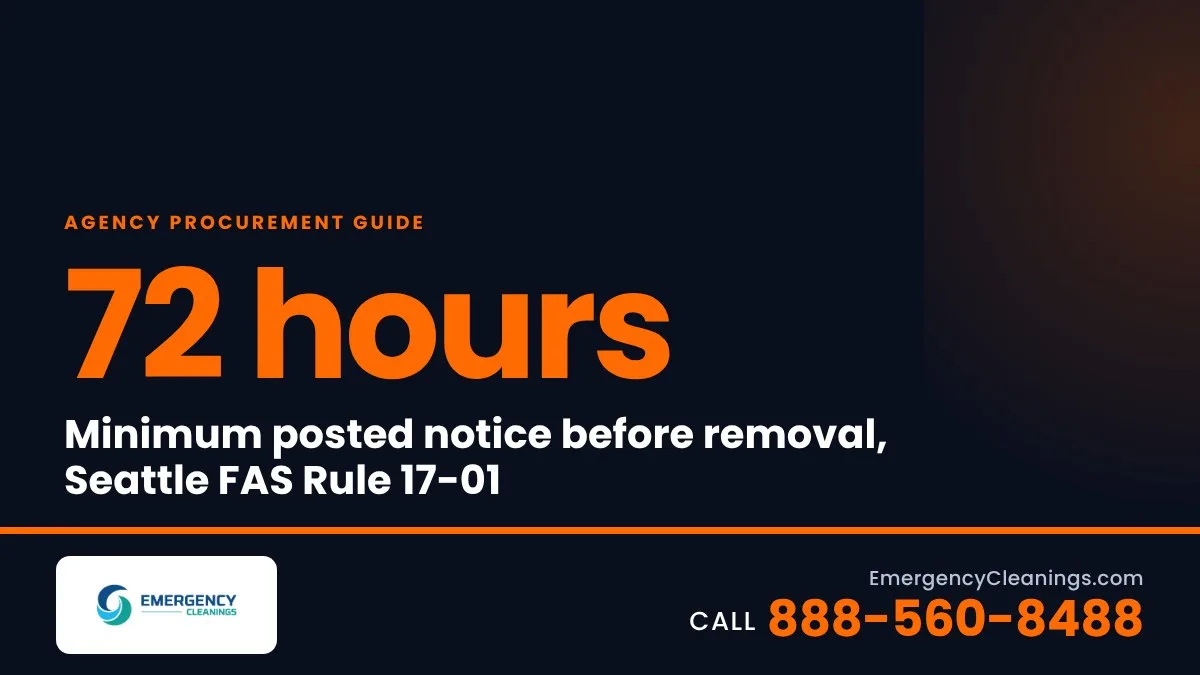
Your city’s ordinance or administrative rule controls, and the details differ from place to place. Seattle’s rule is a useful reference point. Notice must be posted no fewer than 72 hours before an encampment removal, with a removal date no more than 7 days after posting. Obstructions and immediate hazards can be removed without that notice. Property the city stores can be discarded or donated only after 70 days.
Murrieta’s RFP describes a city storage area where items like identification, medications and eyeglasses are held for 90 days. Whatever your rule says, your vendor’s crew has to know it before they arrive. Ask any bidder how they separate personal property from debris, who logs it, and how it gets to your storage site.
The U.S. Interagency Council on Homelessness also lists “Address Basic Needs and Provide Storage” among its 7 Principles for Addressing Encampments.
Response Time Terms Worth Writing Into the Contract
Response language is where contracts tend to be vague. Murrieta’s RFP asks for a minimum of 72 hours’ notice before a cleanup starts, unless an emergency or public health situation can be declared. Spell out both tracks in yours:
- Scheduled clearances tied to your posted notice date
- Emergency calls with a defined arrival window in hours
- Who can place an emergency order by phone, and how fast it gets confirmed in writing
- What the vendor sends at closeout, such as photos, a site report and disposal records you can request
- Required insurance, including general liability, auto, workers comp and pollution liability, with your agency as additional insured
Murrieta, for example, asks for general liability of $2,000,000 per occurrence and pollution legal liability of at least $1,000,000 per occurrence. Your risk manager sets your numbers.
How Emergency Cleanings Fits Your Process
Emergency Cleanings coordinates vetted local technicians nationwide, so a crew can be on site the same day you call. A technician arrives inside a 2-hour window, walks the site and photographs it. A coordinator then calls you with one flat price and the step-by-step plan, covering labor, disposal, transport, equipment and insurance. That price is set before any work begins and does not change after the final scope is agreed. You get before and after photos for the file. Details on the service are on our homeless encampment cleaning page.
If your agency needs vendor registration paperwork or a certificate of insurance before a first job, tell us at the start, and we will work through your onboarding steps with your purchasing office.
Frequently Asked Questions
How do cities usually contract homeless encampment cleanup?
Through a competitive RFP for an on-call services contract, through small-purchase rules for jobs under a local dollar threshold, or through emergency procurement when a hazard cannot wait for a bid. Your state law and purchasing policy decide which route applies.
How much notice is required before an encampment cleanup?
It depends on the city. Seattle requires posted notice at least 72 hours before removal, with exceptions for obstructions and immediate hazards. Check your own ordinance or administrative rule.
Did Grants Pass v. Johnson end property storage requirements?
No. Grants Pass addressed whether enforcing camping laws violates the Eighth Amendment. Lavan v. City of Los Angeles still bars cities in the Ninth Circuit from summarily destroying unabandoned property, so notice and storage rules remain in place.
Can federal grant money pay for an emergency encampment cleanup without a bid?
Under 2 CFR 200.320, noncompetitive procurement is allowed when a public exigency or emergency will not permit the delay of a competitive solicitation. Document the reason in the procurement file.
When a site needs clearing, call 888-560-8488. Emergency Cleanings offers same-day response and a free on-site assessment, and you get a written scope with one flat price locked before work starts.