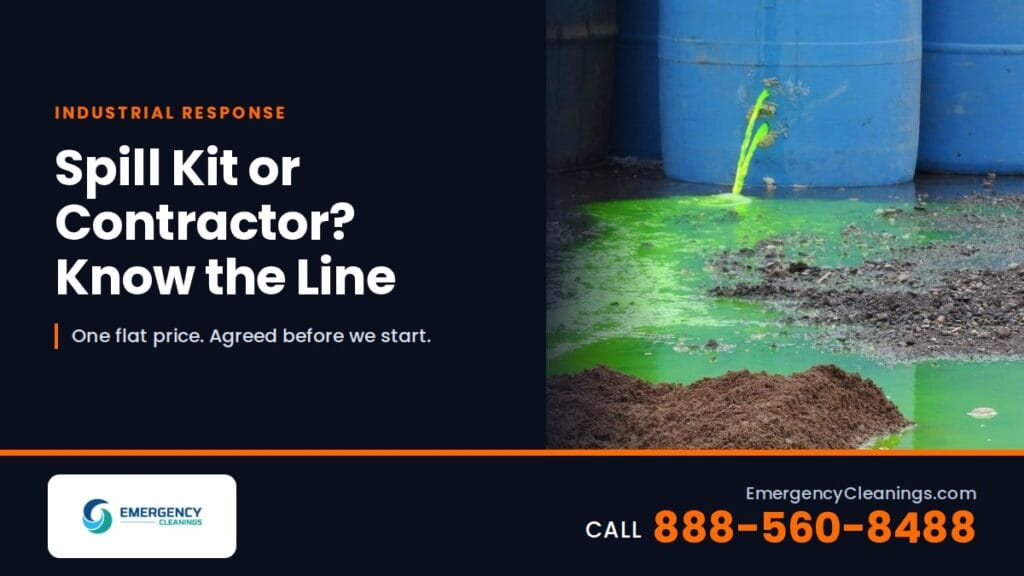
In-house staff can finish a chemical spill when the product is confirmed on an SDS, the release is contained on a hard surface with no path to a drain, sump, soil, or water, no respiratory protection or permit-space entry is needed, and the responders hold current HAZWOPER training. It goes to a contractor when the substance is unknown, a reportable quantity was crossed, the release reached soil or water, or the waste needs characterization your site cannot do. Emergency Cleanings handles the contractor side nationwide with vetted, licensed, insured local technicians, at a flat fee locked after an on-site scope.
The release is contained and the area is roped off. Now you decide whether your own people finish it or you open a PO for an outside crew — knowing corporate EHS will read the incident file, and knowing the wrong answer either burns a shift of unbudgeted downtime or creates a citation you cannot walk back.
Plants get this wrong in both directions. Some call a chemical spill cleanup contractor for a 15-gallon coolant release an operator could absorb in twenty minutes. Others put maintenance techs in half-face respirators inside a sump because the drum was “only” 55 gallons. Here is the line OSHA and EPA actually draw.
The regulatory line is not volume. It is control and exposure.
Under HAZWOPER, OSHA defines an emergency response as “a response effort by employees from outside the immediate release area or by other designated responders … to an occurrence which results, or is likely to result, in an uncontrolled release of a hazardous substance.” Opposite it sits the exemption: an incidental release is one that “can be absorbed, neutralized, or otherwise controlled at the time of release by employees in the immediate release area or by maintenance personnel,” with no exposure to significant safety or health hazards.
OSHA’s guidance on applying HAZWOPER to worksite response describes incidental releases as “limited in quantity, exposure potential, or toxicity.” The moment you pull people from another department, call the fire department, or put anyone in respiratory protection to approach it, you are in 29 CFR 1910.120(q) and the exemption is gone. Which means the same 55 gallons can be either one: low-hazard glycol on a curbed pad with a trained operator is incidental, while a corrosive that reached a floor drain is an emergency response event no matter how calm the floor looks.
What your spill kit and internal team can legitimately own
An in-house response holds up when all of this is true:
- The chemical is known — you have the SDS in hand, not a guess about what was in the tote.
- It is contained on an impervious surface with no path to a drain, sump, soil, or surface water.
- No respiratory protection is needed to approach it. If it is, you have triggered 29 CFR 1910.134: a written program, a medical evaluation before the employee is fit tested, and a passed fit test before initial use and annually after. “We keep N95s in the cabinet” is not a program.
- No confined space entry. A sump, pit, or vessel that “contains or has a potential to contain a hazardous atmosphere” is a permit-required confined space under 1910.146(b), which obligates a written permit space program, an attendant, and rescue capability.
- Your responders are trained to the level of what they are doing. Per OSHA’s reading of 1910.120(q)(6), operations level requires at least eight hours; hazardous materials technician — the level that plugs and patches at the release point — requires at least 24, plus annual refresher or a documented yearly competency demonstration.
What forces a contractor
Any one of these moves the job outside, and most are not judgment calls:
- You crossed a reportable quantity. CERCLA section 103 requires notice to the National Response Center when an RQ or more of a listed substance is released in any 24-hour period, plus EPCRA 304 notice to your SERC and LEPC where off-site exposure is possible. RQs live in 40 CFR 302.4 and go as low as one pound. For oil the trigger is simpler: a discharge causing “a film or sheen upon or discoloration of the surface of the water” is reportable under 40 CFR 110.3. Reportable events get looked at — have contractor documentation attached when they are.
- The release reached soil, a drain, or water. Recovery becomes an excavation and characterization problem, not an absorbent problem.
- The waste stream is the hard part. Under 40 CFR 262.11 you must make an accurate hazardous waste determination “at the point of waste generation, before any dilution, mixing, or other alteration.” Saturated absorbent, contaminated PPE, and rinse water are all newly generated waste, and one event can push you into a higher generator category for the month (SQG above 100 kg, LQG at 1,000 kg or more). Shipping it off site means a manifest on EPA Form 8700-22 under 40 CFR 262.20.
- Post-emergency cleanup exceeds your training. There is a carve-out worth knowing: OSHA has stated that “a minimum of 24 or 40 hours of training is required for all other post-emergency clean-up workers unless the cleanup is done on plant property using plant or workplace employees” under 1910.120(q)(11)(ii). Your own people on your own property have a path. Anyone you hire needs the full credential — ask to see the cards.
The decision rule
Run it in order. Stop at the first yes.
- Substance unknown or unconfirmed? → Contractor.
- Reached a drain, sump, soil, or water, or crossed an RQ? → Contractor, and notify.
- Requires respiratory protection or permit-space entry your program does not already cover for these employees? → Contractor.
- Will the waste change your generator status or need characterization you cannot do in house? → Contractor.
- None of the above — chemical known, contained on hard surface, responders trained and current? → In-house, documented as an incidental release with the reasoning written down.
That last clause is the part plants skip. A defensible file is not “we cleaned it up.” It is the SDS, the volume, the containment path, the training records of the crew, the waste determination, and the stated reason the incidental exemption applied. Write it at the time, not when the auditor asks.
Working with Emergency Cleanings
Emergency Cleanings takes the events that fall outside your team’s scope. That covers chemical and oil spill cleanup, and broader industrial cleanups scheduled around an outage instead of against one. Our crews carry the HAZWOPER training your file needs to show, and we hand back documentation your corporate EHS group can use.
Pricing is a flat fee. A technician scopes the release on site, we agree price and scope before work starts, and the price does not move afterward — which is what makes it a clean PO rather than an open-ended cost center. For an active release, our emergency cleanup service mobilizes on the call.
Frequently Asked Questions
Who decides whether a spill is incidental or an emergency response?
The plant makes the call, but the criteria are set. A release that can be absorbed, neutralized, or controlled at the time of release by employees in the immediate area or by maintenance personnel, with no significant safety or health hazard, is incidental. Pull in people from outside the release area, call the fire department, or put anyone in respiratory protection, and you are in an emergency response under 1910.120(q).
Does the size of the release decide it?
No. Volume matters only through control and exposure. A 55-gallon glycol release on a curbed pad with a trained operator can be incidental, while a smaller corrosive release that found a floor drain is an emergency response event.
What should we ask a spill response contractor to show us?
Ask for HAZWOPER training records at the level of the work being done, plus proof of licensing and insurance. Ask what documentation comes back afterward, including disposal records you can request.
How is contractor spill cleanup priced?
Emergency Cleanings prices this work as a flat fee. A technician scopes the release on site, price and scope are agreed before work begins, and the number does not move. Assessment is free and larger cleanups can be phased around an outage.
Call 888-560-8488 to scope a release, or to get prequalified before you need one. Assessment is free, the scope is set on site, and the flat price is locked before anyone starts. Same-day response is available, with a two-hour arrival window and an ETA text when the technician is en route.