
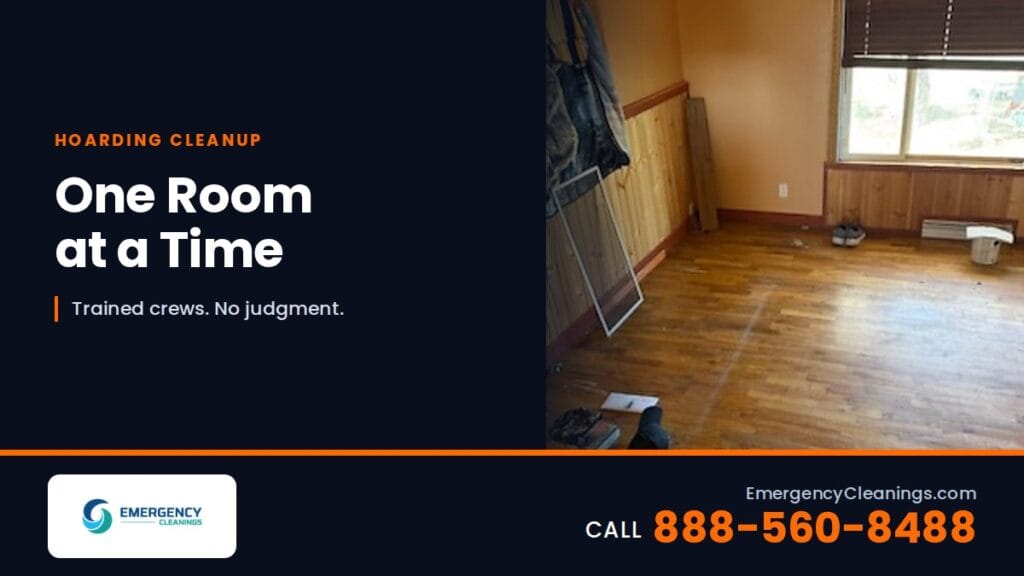
A phased hoarding cleanup is one cleanup split into separate visits, where each phase gets its own written scope and its own flat fee instead of the whole house being priced and cleared at once. It suits anyone who wants the work paid for in pieces and who decides what stays in each room. Emergency Cleanings scopes a phase on site, locks the price for that phase before work starts, and comes back for the next one when you are ready.
You already know what your house looks like. You don’t need it explained to you, and you don’t need another person in your doorway telling you to just rent a dumpster and get it over with. What you probably do need is a straight answer to a different question: if you did this the slow way, one room at a time, paying for it in pieces as you can — what would that actually look like?
That’s what this is. A phased hoarding cleanup is one job broken into separate, self-contained visits — each scoped and paid for on its own, with you deciding what stays. Here’s how one runs, first call through third phase.
The first visit: a technician looks, and nothing gets thrown out
The first visit is a walkthrough, not a workday. A technician looks at the rooms and asks questions — which room matters most to you, whether there’s an inspection date or a letter with a deadline on it. Nothing is bagged. Nothing is loaded. If a truck shows up on day one and starts filling, that isn’t a phased job.
Bring the letter, if you have one. A code notice or landlord letter names specific conditions, and it tells the technician where phase one starts. The International OCD Foundation describes the core problem as clutter keeping rooms from being used as intended, with risks like eviction, fire, and blocked access for emergency responders. A notice names the same things: an exit path, a stove, a bed, a bathroom, a walkway to the panel.
By the end of that visit you have a written scope and a flat fee for phase one, and only phase one. You decide whether to book it.
Phase one: one room, and the paths that reach it
Phase one is usually not the worst room. It’s the room that gets the notice off your back or gives you somewhere to stand — a bathroom, a kitchen, a bedroom, or the exit routes connecting them. A phase runs one to three working days with a small crew. In a study of clean-outs by the University of British Columbia’s Centre for Collaborative Research on Hoarding, the jobs providers described averaged about 16 hours across three days — so one phase is a real unit of work, not a token gesture.
The room gets worked in layers. Obvious trash and spoiled material goes first — the fastest way to make a room safe, and it almost never involves a hard decision. Then bulk: dead furniture, packaging, broken things you’ve already said you don’t want. That layer is ordinary junk removal and it moves fast. If there’s a sanitation problem underneath — a bathroom that stopped working, or pet or human waste that’s been sitting — it’s handled as biohazard work, with the right protection and disposal.
Who decides what stays
You do. Every time. The Association for Behavioral and Cognitive Therapies is direct about this in its hoarding fact sheet: everyone has the right to make choices about their own objects and how they live, and nothing should be thrown away without asking permission first.
Items sort into three destinations, and you call each one:
- Keep — stays, goes back into the finished room.
- Discard — leaves with the crew that day.
- Set aside — you’re not ready to rule on it. Papers, photos, mail, small items. These go into labeled bins and stay in the house, stacked in one defined spot.
Set-aside is what makes phased work possible. You’re allowed to not decide yet. That isn’t failure; it’s the design.
What happens between phases
Between phases the house sits, and that gap is doing work. It’s when money comes together for the next phase, when you go through the set-aside bins at your own speed in a room you can finally walk through, and when you find out whether the cleared room holds.
That last part is the honest reason to work this way. In the UBC research, 62% of clients had not voluntarily chosen the clean-out, close to 70% reacted with at least some distress, and about half of providers said it didn’t really resolve the person’s difficulty with discarding. What did help was continued, lower-intensity work afterward — and only 43% got any. The single-day dumpster isn’t a shortcut. It’s usually a loop.
After phase one, phase two, phase three
After phase one, one room and its access paths are clear, cleaned, and usable, and the hazard named in your notice is gone. The rest of the house looks the way it did. That’s expected. Photograph the finished room — it’s what you show an inspector or a landlord.
After phase two, a second room joins it and the phase-one set-aside bins get resolved: some contents go back into a room that now has space, some finally leave. Phase two usually moves faster, because you’ve done this once.
After phase three, most of the house functions. There’s usually still one holdout space — a garage, a spare room, a storage area — and that’s fine. A house where the kitchen, bathroom, bedroom, and exits work is a house that passes inspection and holds up.
Why the slow version is the serious version
Hoarding disorder has been its own diagnosis since the American Psychiatric Association added it to the DSM-5 in 2013. The harm-reduction approach built on that clinical work starts from a plain observation: people in this situation have usually spent years being pressured to discard, and pressure stopped working a long time ago. The alternative is engagement at the person’s own pace. ABCT says the same about the physical side — clearing a home out from under someone usually fails.
Emergency Cleanings is a cleanup company, not a therapy provider, and we won’t pretend a clean room fixes anything but the room. What we do is the physical work, in the order and at the speed you set.
Working with Emergency Cleanings
A technician scopes the job on site and gives you a flat fee. Price and scope are agreed before any work starts, and the price does not move afterward — no hourly meter, no surprise on the invoice, no upcharge because a room turned out worse than it looked. A single phase can be scoped and paid for on its own, so you’re never committing to a whole-house number you don’t have. When you’re ready for phase two, we scope phase two.
Frequently Asked Questions
How much does a phased hoarding cleanup cost?
There is no hourly meter. A technician walks the home, scopes the phase you want done, and gives you a flat fee for that phase alone, locked before work begins. The assessment is free and financing is available.
How long does one phase take?
Most single phases run one to three working days with a small crew, depending on the room and what is under the clutter. The scope you sign names the rooms and access paths included. If the room turns out heavier than it looked, the price still holds.
Who decides what gets thrown away?
You do, item by item. Nothing leaves the house without your say, and anything you are not ready to rule on goes into labeled set-aside bins that stay with you.
How fast can someone come out for the first walkthrough?
You can usually get a same-day response. You get a two-hour arrival window and a text with an ETA once the technician is on the way. Nothing is bagged or loaded on that visit.
Is the work discreet?
Yes. Every job is treated as confidential and technicians are told the situation is private. Disposal goes through licensed channels, and you can request disposal records for what leaves.
Call Emergency Cleanings at 888-560-8488 for a same-day response and ask for a walkthrough. The assessment is free, a technician scopes the first phase on site, and the flat price is locked before work begins. Nothing gets thrown out on that visit. You can also read how we approach hoarding cleanup before you call.