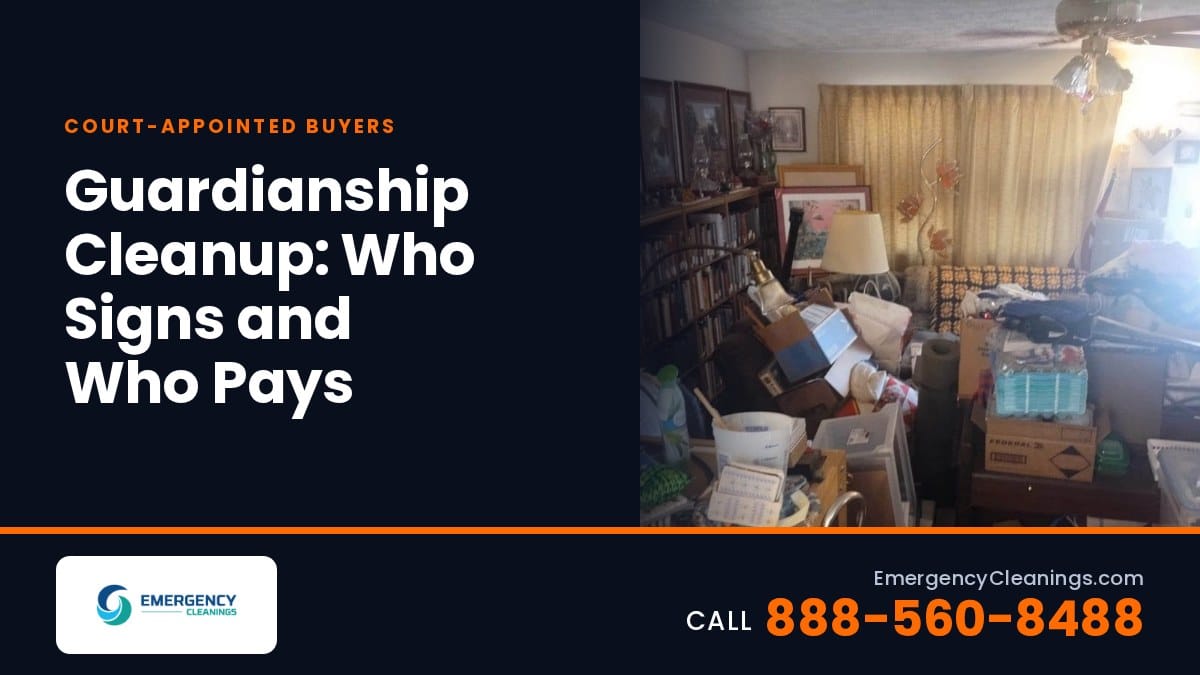
On a property under guardianship or conservatorship, the person who signs for a cleanup is the guardian or conservator of the estate, acting inside the powers the court order gives them, and the bill is paid from the ward’s estate. On a code enforcement receivership, the court-appointed receiver signs and pays, often with money borrowed against the property under court approval. Emergency Cleanings works for either one on a written scope and one flat price locked before work starts, with a job file built to go into a court accounting.
Who signs depends on which appointment you hold
Start with your letters of appointment.
California draws the line in plain text. A conservator of the person covers health, food, clothing and shelter. A conservator of the estate is appointed for someone substantially unable to manage their own financial resources. Only the second one can hire a crew and pay us out of the conservatee’s funds.
Even with estate authority, some acts need a judge first. In Florida, a guardian of the property must get court approval on a petition before making ordinary or extraordinary repairs to buildings, entering contracts in the ward’s best interest, or selling the ward’s personal property. That list sits in Florida Statutes 744.441. Maine requires specific court authorization before a conservator sells or surrenders a lease on the person’s primary dwelling.
Rules vary by state and none of this is legal advice. Read your own order and ask the attorney on the case before the crew arrives.
Where the money comes from on a receivership
A receiver is a different buyer. In California, when an owner ignores a substandard building order, the enforcement agency can ask the court to appoint one under Health and Safety Code 17980.7. The receiver takes full control of the property, manages it and pays operating expenses. With court approval, the receiver can borrow funds to correct the cited conditions and secure that debt with a lien on the property.
Your cleanup budget becomes a line in the financing you take to the judge. The court can later order the owner to pay unrecovered receivership costs.
That timing shapes what you need from a vendor. You need a firm number early, in writing, so it can go into the motion. A range will not survive that hearing.
How the job runs, step by step
- The call. You or the case manager calls 888-560-8488. Tell us who holds authority, whether the ward is still living there, and whether there is a court deadline.
- Arrival. You get a 2-hour arrival window and a text with an ETA when the technician is on the way. Unmarked vehicles are available if the neighbors have been calling code enforcement for months.
- The walkthrough. The technician goes room by room and photographs every one. You can attend, or leave a lockbox code.
- The price. A Project Coordinator calls with the exact final price and the step-by-step plan. It is one flat fee covering labor, disposal, transportation, equipment and insurance. That number is what goes into your petition or financing motion.
- Approval. Work begins when you approve. If the court has to approve first, the price holds while you wait. When the order is in hand, work often starts the same day.
- Phasing. If the estate cannot cover the whole house at once, we split it room by room with a fixed price for each phase. Each phase can be its own approval.
Our hoarding cleanup service handles the sorting, removal and sanitizing. On a receivership the cited conditions often include repairs, and those belong to a licensed contractor. Surface mold gets cleaned as part of the work. Deep mold mitigation, water damage restoration, fire restoration, plumbing repair, and rebuilding are separate trades that Emergency Cleanings does not perform.
What goes in the file for your accounting
A guardian’s invoice gets read twice. You read it when you pay it. A court examiner reads it again, sometimes two years later.
Florida requires a guardian to get a receipt, canceled check or other proof of payment for every expenditure and keep those papers for three years after discharge, under 744.3678. California conservators file their first account a year after appointment and then at least every two years, and must let court representatives inspect their books and receipts, under Probate Code 2620.
Emergency Cleanings hands you a job file built for that reading:
- Before and after photos of each room, dated.
- The written scope you approved, matched to the invoice line for line.
- A log of items set aside, such as papers, jewelry, photographs and anything marked in the scope.
- Disposal records you can request, showing where the material went.
The set-aside log matters most. A ward may come home. A family member may challenge what left the house. Photos of a box of bank statements sitting in the hallway, labeled and handed to you, end that argument fast. Our checklist for documenting before disposal covers what to flag in the scope.
If the case came to you through Adult Protective Services, this piece on APS referrals and payment walks through that side.
When the ward still lives there
A cleanout on an occupied house is slower, and it should be. We work at the pace the person can tolerate and keep items they want to see before anything goes. If the person needs support after the house is cleared, the International OCD Foundation keeps a directory of help.
Frequently Asked Questions
Can a guardian of the person hire a cleanup crew?
Usually not with the ward’s money. Paying from the estate takes authority over the estate, so a guardian of the person alone often needs the estate guardian or a court order to sign.
Does a guardian need court approval before a hoarding cleanup?
It depends on the state and the order. Florida requires court approval before a property guardian makes repairs or enters certain contracts, so check your letters and ask the attorney on the case.
How does a receiver pay for a cleanup?
In California a receiver can borrow against the property with court approval to correct cited conditions, and the court can order the owner to pay unrecovered receivership costs.
Will the price change after the court approves it?
No. Emergency Cleanings sets one flat price after the on-site walkthrough and locks it before work starts, so the number in your petition is the number on the invoice.
Call 888-560-8488 for a same-day response. The assessment on site is free, you get a written scope, and one flat price is locked before work starts.