
A trash out service is the removal-only cleanup a rental needs after a tenant leaves: a crew hauls out furniture, belongings, and debris and hands the unit back empty and broom-clean. It is the right buy when nothing biological soaked into the building; once odor, waste, or pests are involved, the job becomes a full cleanout. Emergency Cleanings scopes the unit on site and sets a flat fee before work starts, so you pay for the job the unit needs.
The tenant is gone, the keys are back, and the unit is full of what they didn’t take. You’re in the doorway doing math: every week this place isn’t photographed and listed is a week of carrying costs with nothing coming in against them. The national rental vacancy rate was 7.3 percent in the second quarter of 2026 — renters have options, and a unit that shows badly sits while better-looking units nearby lease.
The question isn’t whether to clean it — it’s how much cleaning to buy. Buy too much and you burn cash you didn’t need to spend. Buy too little and you pay twice and lose a second vacancy cycle. Here’s the honest side-by-side on rental property trash out vs cleanout.
A trash-out is removal
A crew empties the unit. Furniture, mattresses, clothing, boxes, food in the cabinets, the garage pile — bagged, carried out, hauled, disposed of. Floors swept, surfaces wiped, unit back to you empty and broom-clean.
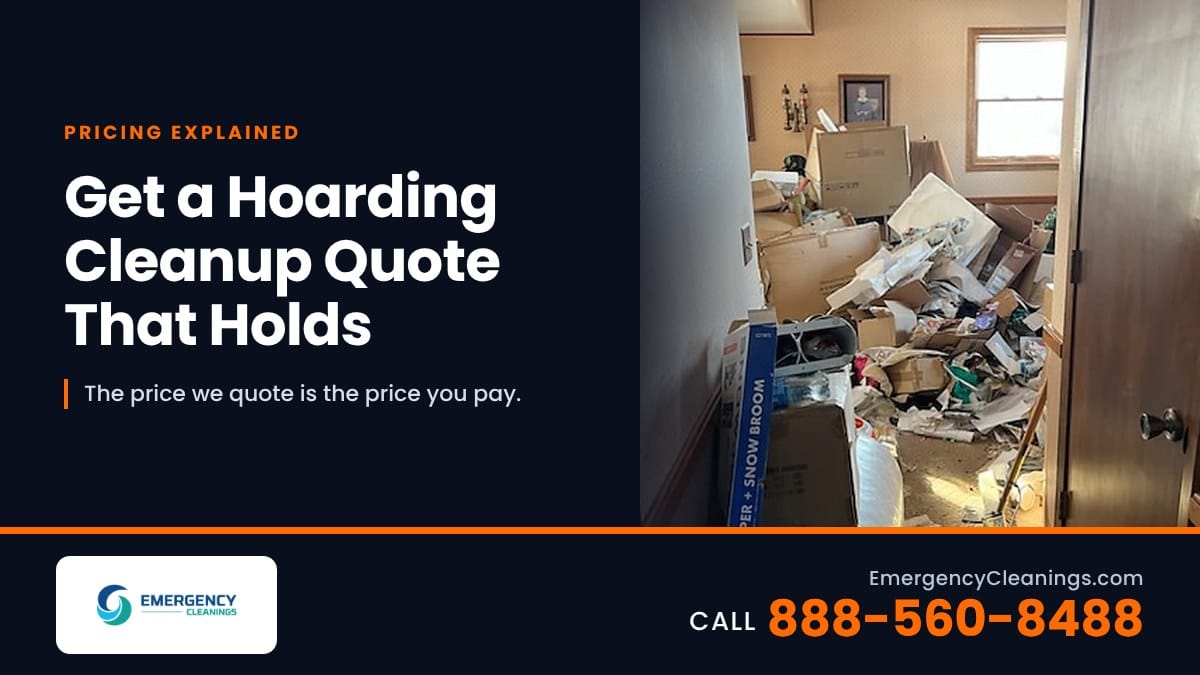
That’s the whole scope, and for a large share of units it’s the complete answer. A tenant who left in a hurry, an inherited house full of forty years of furniture, a resident who simply kept too much — that needs trucks and labor, not decontamination. It’s junk and debris removal. Paying for a biohazard scope on a unit that only needed emptying is waste, and a company that sells you one isn’t on your side.
A full cleanout is removal plus decontamination
Same removal, then dealing with what it exposes — because once the furniture is out, you find out what was under it:
- Animal and human waste — urine and feces in carpet and pad, a bathroom that stopped functioning, rodent droppings and nesting material in cabinets and insulation. That’s feces and biohazard cleanup.
- Sharps — needles in drawers and couch cushions, which no labor crew should be told to grab by hand.
- Porous material that absorbed it — carpet pad, subfloor, the lower two feet of drywall, cabinet bases. What soaked in doesn’t wipe off; it gets cut out and taken away.
- Appliances and HVAC — a refrigerator unplugged with food in it, a greased-up range, ducting that pulled odor through the whole unit.
- Odor at the source — not masked. The source material leaves the building.
A trash-out makes the unit empty. A full cleanout makes it rentable.
The decision rule
Walk the unit. Any one of these means you need the full version — not two, not a majority. One.
- Odor that survives removal. The most reliable trigger there is. Take a load out; if the room still smells, the smell is in the building, not in the pile.
- Biological contamination of any kind. Urine, feces, blood, decomposition, sewage backup. Cleanup after a death in the unit is never a trash-out.
- Rodent droppings or nesting material. CDC guidance on cleaning up after rodents is explicit: don’t sweep or vacuum them, because that puts particles in the air. Air the space out, wet the material with disinfectant, let it soak, wipe it up, and bag contaminated insulation for removal. Not a broom-clean scope.
- Cat feces outside the litter box. CDC notes the Toxoplasma parasite becomes infectious 1 to 5 days after it’s shed. In a unit that’s been sitting, that window closed long ago.
- Active pest infestation. Roaches, fleas, bed bug evidence. Removal alone relocates the problem into the next tenant’s furniture.
- Staining that reached the pad, the subfloor, or the cabinet bases.
- Anything a prospective tenant will smell on the walkthrough. The only test that matters commercially.
None of those present? Buy the trash-out. Genuinely — most units don’t have any of them, and the smaller job is the right job.
What “biohazard” means, since vendors abuse the word
Before someone quotes you a scope: OSHA’s Bloodborne Pathogens Standard, 29 CFR 1910.1030, does not cover feces and urine. In a July 30, 2007 interpretation letter, OSHA states that urine, feces and other human waste are not “other potentially infectious materials” unless visibly contaminated with blood. A vendor waving that regulation at you to justify a bigger number on a urine-soaked carpet is bluffing.
The reason to pull that carpet is that habitability law generally requires you deliver a clean unit — California’s statute makes a dwelling untenantable if it isn’t “free from all accumulations of debris, filth, rubbish, garbage, rodents, and vermin” — and that a tenant will smell it and walk. Check your own state’s wording; the obligation is mostly the same.
What the cheap version costs on the wrong unit
The failure mode is predictable. The unit gets emptied. It reads fine on the walkthrough because the windows have been open two days. You bring in paint and carpet, shoot photos, list it. Then it sits closed over a warm weekend, or the HVAC runs for the first time, and the odor comes back into a freshly finished space.
Now you get showings where people go quiet in the hallway and never apply — or a tenant who signs and files a habitability complaint in week three. The re-do is worse than the original job, because you’re demolishing work you already paid for: pulling carpet you just laid, cutting drywall you just painted. And the second vacancy runs through a stretch you had budgeted as occupied. The lost rent dwarfs the gap between the two quotes, which is why getting the scope right the first time is a financial decision, not a squeamishness one.
If the unit is packed floor-to-ceiling and you can’t see the floors to judge any of this, that’s its own category — see hoarding cleanup — and the scope gets set after the first layer comes out.
Frequently Asked Questions
How quickly can a trash out service get to my rental?
Emergency Cleanings dispatches vetted, licensed, insured local technicians nationwide, and a same-day response is the norm. Call with the address and your target list date. The technician walks the unit, sets the scope, and the crew is scheduled around that date.
What happens when a trash-out turns out to involve feces, needles, or a death?
The crew stops and the scope changes before anything else moves. Waste, sharps, and decomposition are handled by technicians equipped for biohazard work, and the porous material that absorbed it leaves with them. You get a revised flat price for the larger job, and you approve it before that work begins.
How does a flat price protect my deposit accounting?
The price is set after the on-site scope and locked before work starts, so the number you charge against the security deposit is the number on the invoice. No hourly meter, no change order. One final figure is far easier to defend on a deposit statement than a running total.
Does a trash-out cover mold, water damage, or fire smoke?
No. A trash-out and a full cleanout deal with contents, waste, contamination, and the material it soaked into. Surface mold gets cleaned as part of the work. Deep mold mitigation, water damage, and fire restoration are separate trades, and our crews do not perform those. If the unit has those problems, the technician will say so during the scope.
Working with Emergency Cleanings
A technician scopes your unit on site and tells you which of these two jobs it is — including telling you it’s the smaller one when it’s the smaller one. You get a flat fee and a scope agreed before any work starts, and the price does not move afterward. No hourly meter, no change order because a room was worse under the furniture than it looked over it.
Call 888-560-8488 for a same-day response. The assessment is free, the technician scopes the unit on site, and the flat price is locked before work begins. Bring your target list date, since that is the number the schedule is built around.