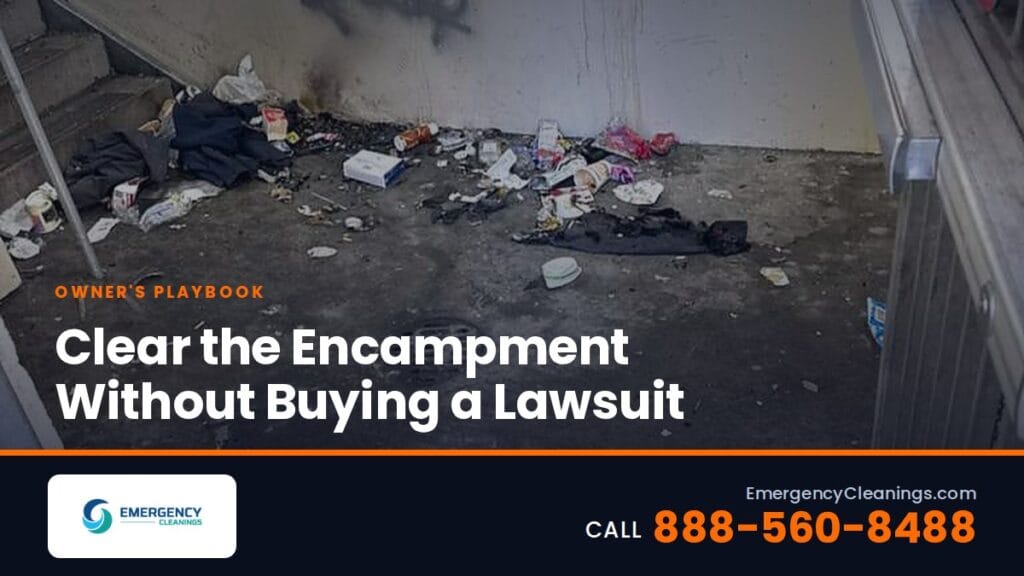
Encampment cleanup on private property is the removal of tents, debris, sharps, human waste and abandoned material from a commercial parcel after the owner has met local notice and trespass requirements. Done responsibly, personal property is inventoried and stored rather than thrown out, biohazards go into the correct waste streams, and the owner gets a documentation package for the file. Emergency Cleanings performs this work nationwide for owners and managers at a flat fee, locked in writing after an on-site scope.
It usually starts as a nuisance and becomes a file. A few tents appear in the loading alcove behind the retail strip, or on the vacant parcel you have been holding for a build-out. Your anchor tenant emails photos. Somebody dumps a mattress. Then the city sends a notice giving you a deadline to abate the condition on your parcel, and suddenly the thing you were hoping would resolve itself is a liability item with a date on it.
This is the owner’s version of the problem, and it is different from the city’s. You are not deciding public policy. You are trying to clear your property without creating a lawsuit, without exposing a crew to a needlestick, and without losing the tenant who has been asking about it for a month. Here is the sequence that gets you there.
Why this is your problem and not the city’s
In City of Grants Pass v. Johnson (2024), the Supreme Court held that enforcing generally applicable public camping ordinances does not violate the Eighth Amendment. That changed how many municipalities handle public land. It did nothing to make an encampment on private property a public agency’s obligation.
On private ground, the owner is generally the party who has to act, and the party who gets sued if the action goes badly. Municipal enforcement usually arrives as a nuisance or abatement notice pointed at you — with a clock, and often per-day penalties behind it. The risk sits in one place: you are required to clear it, and you are exposed if you clear it wrong.
The legal sequence happens before anyone picks up a shovel
Requirements here vary by state, county and city, and they vary enormously. Nothing below is legal advice, and the first call an owner should make is to counsel who practices in the specific jurisdiction where the parcel sits. What follows is the shape of what owners commonly have to deal with, so you know what to ask about.
Notice and trespass
Most jurisdictions expect some form of notice before removal, and expect the local police or sheriff to handle the trespass component rather than a private crew. Some states have written the sequence into statute. Oregon’s ORS 195.505 requires at least 72 hours of posted written notice before removing individuals from an established camping site, and requires personal property to be stored for a minimum of 30 days and kept reasonably available to anyone claiming ownership.
Read that statute carefully, though: it is written for law enforcement and public bodies, not as a private-property rulebook. That is the trap. Owners tend to assume either that the public-body rules bind them directly or that no rules bind them at all, and neither assumption is safe. Many cities have their own ordinances, some of which do reach private parcels, and your abatement notice may itself specify a process. Confirm the local notice period, posting language and any storage obligation with counsel before you schedule a crew.
The belongings problem, which is the expensive one
The single most common way an owner turns a cleanup into litigation is by throwing away someone’s property. The leading case that made this vivid is Lavan v. City of Los Angeles, 693 F.3d 1022 (9th Cir. 2012), in which the Ninth Circuit held that “the Fourth and Fourteenth Amendments protect homeless persons from government seizure and summary destruction of their unabandoned, but momentarily unattended, personal property.”
Lavan is a constitutional case about a government actor, so it does not directly govern a private owner. But it set the tone for how these disputes are litigated, and private owners face their own version of the exposure through state law — conversion and trespass-to-chattels claims, and state abandoned- and found-property statutes. California’s Civil Code § 2080 illustrates the general principle: a person who takes charge of found property “is thenceforward a depositary for the owner,” with a duty to inform a known owner and make restitution.
The practical translation: a tent, a bicycle, medication, ID documents and a duffel bag are not the same thing as trash, and a crew that cannot tell the difference can cost you far more than the cleanup. The defensible pattern is to segregate apparent personal property, photograph and inventory it, bag and tag it, store it for whatever period local rules or your counsel specify, and dispose of only what is plainly refuse or contaminated beyond salvage.
What a lawful cleanup sequence actually looks like
- Document the pre-existing condition — dated, geotagged photos and video before anyone touches anything.
- Confirm the local process with counsel — notice period, posting requirements, law enforcement presence, storage duty.
- Post notice as required and photograph it in place, with a timestamp and a wide shot showing placement.
- Coordinate the trespass step with local law enforcement. Contractors clear sites; they do not remove people.
- Site assessment before entry — a walk for sharps, cylinders, structural hazards, animals and chemical containers, with the scope built from what it finds.
- Segregate and inventory personal property per the storage rule that applies.
- Remove, decontaminate, dispose under the right waste streams.
- Close-out documentation for your file, your carrier and your tenant.
The hazards are real, and they are not the ones people expect
Anyone scoping this work should be planning around a specific hazard list. On a typical encampment cleanup site, crews encounter:
- Needles and other sharps, in bedding, buried in soil, and in the seams of furniture where a gloved hand finds them the hard way.
- Human waste, often in volume and often in containers, plus saturated bedding and cardboard.
- Propane cylinders and camp fuel, often still charged and often near burn areas.
- Rodent harborage and droppings under pallets, tarps and debris piles.
- Charred debris and burn scars from cooking and warming fires, which conceal sharps and collapse underfoot.
- Unlabeled chemicals — solvents, automotive fluids, unknown liquids in food containers.
Getting the OSHA question right
There is a widespread misconception worth correcting, because it changes how the work is planned. OSHA’s Bloodborne Pathogens Standard, 29 CFR 1910.1030, applies to occupational exposure to blood and other potentially infectious materials, and it plainly covers contaminated sharps — the standard defines those as “any contaminated object that can penetrate the skin including, but not limited to, needles, scalpels, broken glass.”
Human waste is a different matter. In an August 7, 2007 interpretation letter, OSHA stated that “urine, feces, and other reasonably anticipated biological components comprising human wastes in sewage are not included in the standard’s definition of ‘other potentially infectious materials’ unless . . . visibly contaminated with blood.” That does not make the exposure unregulated: OSHA’s general PPE standard, 29 CFR 1910.132, still requires the employer to assess the workplace for hazards and provide appropriate protection. It means a competent contractor knows which rule governs which hazard — and you will learn a lot about a contractor from the answer.
PPE and disposal, in plain terms
The defensible setup includes cut- and puncture-resistant gloves over nitrile, eye protection, coveralls, boot protection, and respiratory protection where dust and rodent droppings are in play. Sharps go into closable, puncture-resistant, leakproof, labeled containers — the construction 1910.1030 specifies — never into a contractor bag. NIOSH’s Needlestick and Other Sharps Injuries (NIOSH 2012-123) is blunt about bringing proper containers to the site rather than improvising, and about the immediate wash-report-treat sequence if someone is stuck.
Rodent-contaminated areas should never be swept or vacuumed dry. CDC’s cleanup guidance is to spray with disinfectant or bleach solution until wet, let it sit, then wipe up — dry methods aerosolize exactly what you are trying not to breathe. Human waste and biological contamination gets its own containment, decontamination and waste stream, separate from general debris moving out under bulk debris removal. Propane cylinders and unidentified chemicals are set aside rather than thrown in a load — a cylinder in a compactor is somebody’s very bad day.
Documenting for insurance and for the claim that may never come
Assume you will have to explain this cleanup eighteen months from now to a carrier, a plaintiff’s attorney, a code officer or a buyer’s diligence team. Build the file at the time; you cannot reconstruct it later:
- Before, during and after photography with dates, including wide shots establishing location.
- The posted notice, photographed in place, with the date and time it went up.
- A personal property inventory — what was found, tagged, stored where, and how someone could claim it.
- Manifests and disposal records for each waste stream, especially sharps and hazardous materials.
- The written scope and price agreed before work started.
- The site assessment and what hazards it identified.
That package turns “we cleaned it up” into a documented, reasonable, professionally executed abatement — and it is what your carrier will want if a claim arrives later.
Preventing recurrence, because clearing it once solves nothing
Owners who clear a site and do nothing else are usually back within weeks. The measures that change the outcome are physical and procedural: lighting the alcoves and setbacks that are currently dark; securing the specific access point being used, not the perimeter in general; removing the cover that made the spot attractive — overgrown vegetation, stacked pallets, abandoned equipment; closing recessed loading areas after hours; a documented walk cadence so somebody notices at week one instead of month three; and keeping trespass paperwork current with local law enforcement so response does not start from zero each time.
For vacant land, the honest answer is often that clearing is a recurring line item until site conditions change. Budget it that way. Larger yards and industrial parcels are handled as industrial cleanups — a different scale of equipment and staging than one alcove behind a retail strip.
Working with Emergency Cleanings
We do encampment and debris cleanups on private commercial property — retail, office, warehouse, vacant land and mixed-use. A technician scopes the site in person, and we quote a flat fee: price and scope are agreed in writing before work starts, and the price does not move afterward. An open-meter number is not something you can put in front of an asset manager or a carrier.
We work to the notice and property-storage sequence your counsel specifies, segregate and document personal property rather than making that call ourselves, handle sharps and biological contamination under the correct waste streams, and hand you a documentation package at close-out. Where a site has to be cleared on a deadline, emergency cleanup scheduling is available.
Frequently Asked Questions
What does a responsible encampment cleanup on private property look like?
Counsel confirms the local notice and trespass process first. Law enforcement handles anyone still on site; the crew clears what is left. Apparent personal property is set aside for storage, sharps and biological waste go out under their own streams, and close-out includes photos, an inventory and disposal records.
Do I have to post notice before clearing an encampment on my own land?
In many jurisdictions, yes, and the notice period and posting language vary by city and state. This is not legal advice. Ask counsel who practices where the parcel sits, then photograph the notice in place with a timestamp before you schedule a crew.
How are needles and human waste handled during the cleanup?
Sharps go into puncture-resistant, labeled containers brought to the site, never a contractor bag. Human waste and saturated bedding are contained, decontaminated and disposed of separately from bulk debris. Technicians work in puncture-resistant gloves, coveralls and eye protection, with respirators where dust and droppings are present.
How does pricing work for an encampment cleanup?
A technician scopes the site in person first. You then get a written scope and a flat fee, and that price is locked before work starts. There is no hourly meter and no added line for extra loads. The assessment is free.
Call Emergency Cleanings at 888-560-8488 for a same-day response. The assessment is free, a technician scopes the site in person, and your flat price is locked in writing before any work begins.