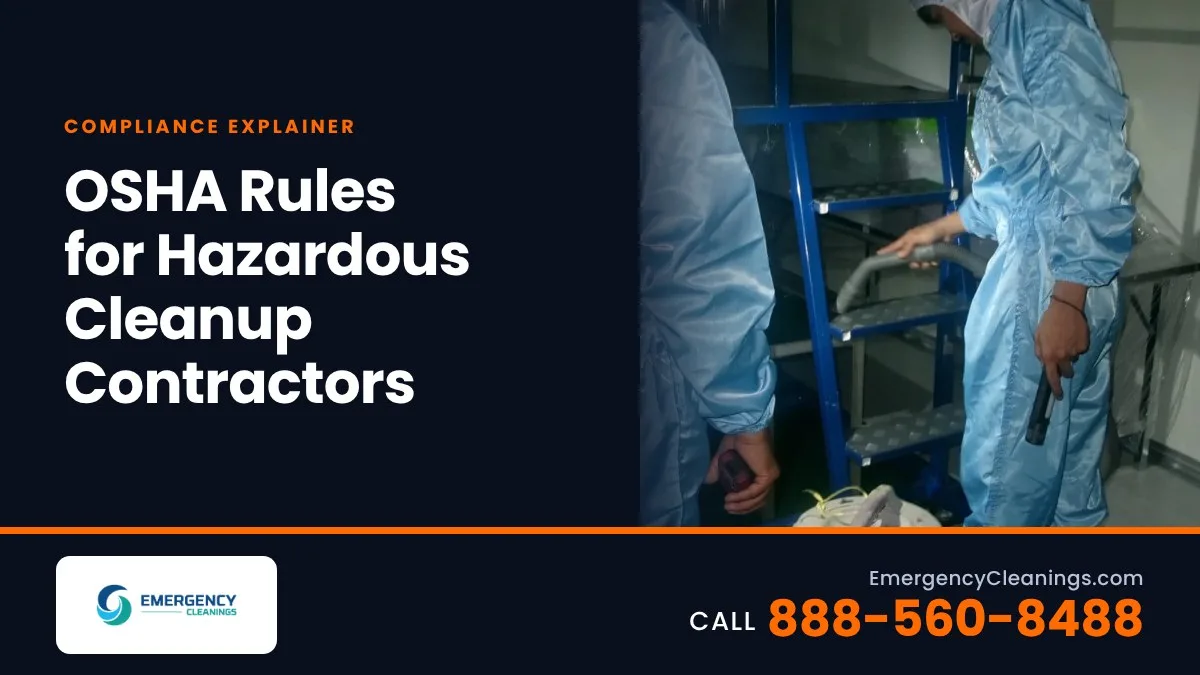
OSHA hazardous cleanup requirements depend on what spilled and where your contractor works: HAZWOPER applies to emergency responses and regulated cleanup sites, while Hazard Communication, PPE, respiratory protection, confined space, bloodborne pathogens and housekeeping rules cover most routine industrial cleanups. As the host facility, you keep duties of your own even after the contractor arrives. Emergency Cleanings coordinates vetted local industrial crews and walks your site for free before any price is set.
A drum split on the dock. Or your EHS lead flagged a housekeeping finding that has to close before the next audit. You need a crew in, and you need the paperwork to hold up afterward.
Does HAZWOPER Apply to Your Cleanup?
The HAZWOPER standard at 29 CFR 1910.120 covers five kinds of work: cleanups required by a government body, corrective actions at RCRA sites, voluntary cleanups at sites a government body recognizes, hazardous waste operations at treatment, storage and disposal facilities, and emergency response to releases or threatened releases of hazardous substances.
Most plant spills fall into that last bucket or outside the standard entirely. The definition of emergency response in 1910.120(a)(3) excludes incidental releases, where the substance can be absorbed, neutralized or otherwise controlled at the time of release by employees in the immediate area or by maintenance personnel.
How OSHA Draws the Incidental Line
OSHA has said in interpretation letters that this is a case-by-case call. A 1992 letter describes incidental releases as limited in quantity and posing no emergency or threat to workers nearby. It also says a spill is not an emergency just because someone from outside the area cleans it up. A 2017 letter lists factors to weigh, including release quantity and rate, toxicity, breathing-zone exposure, and the training and equipment of the responders. It adds that your emergency action plan should spell out the criteria. Write them down before the next spill, so your contractor and your auditor read the same rule.
The Standards That Cover Routine Cleanup Work
Hazard Communication, 1910.1200
When your chemicals can expose another employer’s workers, 1910.1200(e)(2) requires your hazard communication program to say how the contractor gets access to your safety data sheets. It must also cover how you tell them about precautions and your labeling system. Hand over the SDS for whatever spilled before the crew opens a bag of absorbent.
Personal Protective Equipment, 1910.132
Under 1910.132(d), an employer has to assess the workplace for hazards that call for PPE and verify it with a written certification. Workers who wear PPE must be trained on its use and limits. Ask the contractor for its hazard assessment for your job.
Respiratory Protection, 1910.134
If the cleanup needs respirators, 1910.134 requires a written respiratory protection program, a medical evaluation before an employee is fit tested or uses the respirator, and fit testing for tight-fitting facepieces before first use and at least annually after that. Ask to see fit test dates for the people coming to your site.
Permit-Required Confined Spaces, 1910.146
Sumps, pits, tanks and vessels often meet the definition in 1910.146. When a contractor enters, the host has to tell them the spaces are permit spaces, share the known hazards and the precautions already in use, coordinate entry, and debrief them afterward. The contractor has to tell you which permit program it will follow.
Bloodborne Pathogens, 1910.1030
Where blood is present, such as after an injury on the line, 1910.1030 covers occupational exposure to blood and other potentially infectious materials. Covered employers need a written exposure control plan and must offer the hepatitis B vaccine within 10 working days of initial assignment. Feces and urine are a separate question. OSHA’s 2007 interpretation says they are not included unless visibly contaminated with blood.
Walking-Working Surfaces, 1910.22
The cleanup itself answers to 1910.22(a), which requires workplaces to be kept clean, orderly and sanitary and surfaces kept free of hazards that include leaks and spills. Residue left on the floor is still your finding.
Who Gets Cited at a Multi-Employer Site
OSHA’s multi-employer citation policy sorts employers into four roles: creating, exposing, correcting and controlling. The controlling employer has general supervisory authority over the site, with power to correct violations or require others to. On your property, that is usually you.
OSHA applies a two-step test. Which role do you hold, and did you meet its duties? A creating employer can be cited even when the only exposed workers belong to someone else. Reasonable care on your side means checking the contractor’s program before work and watching it during the job.
What to Ask a Contractor for Before They Start
- Written safety program covering respiratory protection and confined space procedures if they apply.
- Training records for the assigned crew, including HAZWOPER level if 1910.120 applies and fit test dates.
- PPE hazard assessment for the task.
- SDS handling plan for your chemicals and any they bring on site.
- Written scope naming each area, the material, what done looks like, and where the waste goes.
- Certificate of insurance matching your purchasing requirements.
- Disposal records you can request after the job.
Get this before you cut the PO. Prequalification that starts after the spill burns days you do not have.
How Emergency Cleanings Handles Industrial Jobs
A technician walks and photographs your site with your team. A Project Coordinator then calls with the exact final price and the step-by-step process. The flat fee covers labor, disposal, transport, equipment and insurance, and once the final scope is set the price does not change. Send your prequalification packet to Emergency Cleanings during the walkthrough so the coordinator can tell you what the assigned crew can provide. See the industrial cleanups page for scope, or chemical and oil spill cleanup if the job started with a release.
Frequently Asked Questions
Does every chemical spill cleanup require HAZWOPER training?
No. HAZWOPER’s definition of emergency response excludes incidental releases that employees in the immediate area or maintenance personnel can absorb, neutralize or otherwise control at the time of release. OSHA says the employer decides case by case.
Who is responsible for OSHA compliance when a contractor cleans my facility?
Both of you. Under OSHA’s multi-employer citation policy, the host is usually the controlling employer and must use reasonable care to prevent and detect violations, while the contractor answers for its own workers and any hazards it creates.
Does the Bloodborne Pathogens Standard cover feces and urine cleanup?
Not by itself. OSHA’s 2007 interpretation says urine and feces are not covered as other potentially infectious materials unless they are visibly contaminated with blood.
Do I have to give a cleanup contractor my safety data sheets?
If your chemicals could expose the contractor’s employees, your hazard communication program must include how you will give them access to the safety data sheets for those chemicals.
Get a Crew Scheduled
If you have a spill, a finding to close, or a cleanup on the outage list, call 888-560-8488. We offer same-day response and a free on-site assessment, and you get a written scope with one flat price locked before any work starts.