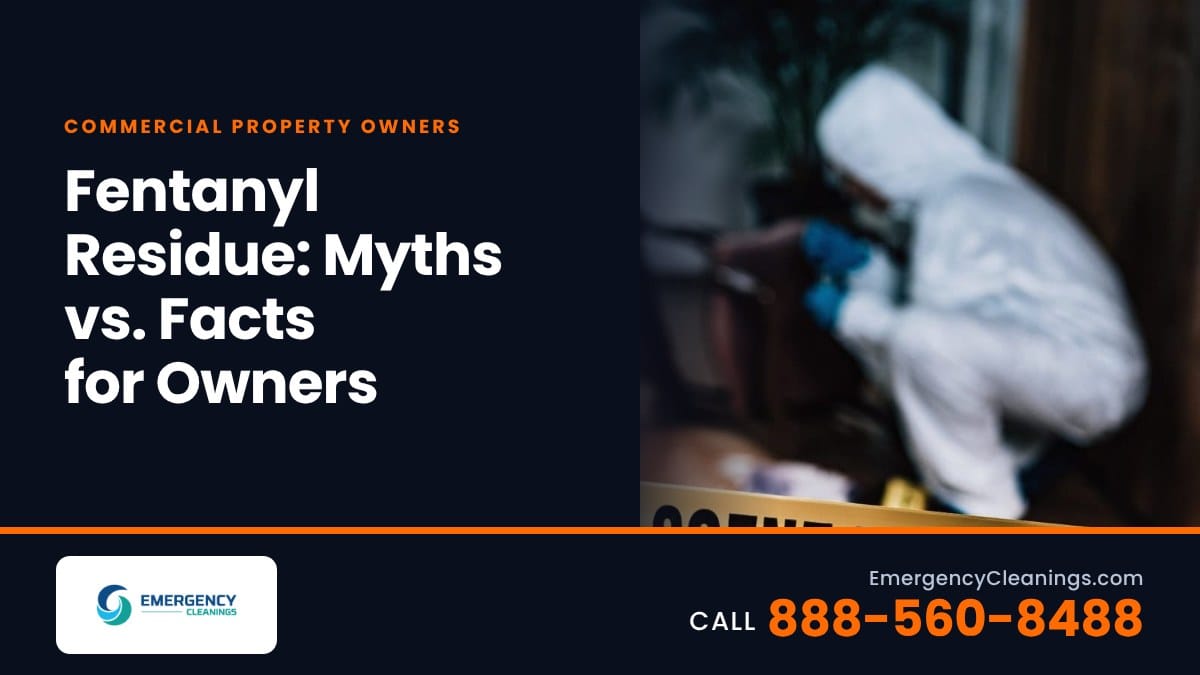
Fentanyl decontamination is the removal of drug residue, paraphernalia and related waste from a property, followed by cleaning of the surfaces it touched. Medical toxicologists say brief skin contact is very unlikely to poison anyone, so the job calls for trained people and the right gear rather than panic. Emergency Cleanings handles drug residue cleanup in commercial properties for one flat fee set after a free on-site walkthrough.
Maybe a tenant got evicted and the locksmith found foil and powder in the back office. Maybe squatters were in a vacant suite. You own the building, and you want to know how dangerous this is and how fast the space can be leased again. Here are the common myths next to what the evidence says.
Myth: Touching Fentanyl Residue Can Kill You
Fact: The American College of Medical Toxicology and the American Academy of Clinical Toxicology put it plainly in their joint position statement. Incidental dermal exposure is exceedingly unlikely to cause opioid intoxication.
Exposed skin should be washed promptly with water, and nitrile gloves add protection. The Minnesota Department of Health reports no credible evidence that anyone has been sickened simply by entering an area where fentanyl was present, or even by having fentanyl get on their skin.
Powder on a desk is still a hazard if it gets swallowed or into eyes or mouth. Keep staff and tenants out of the room until it is cleaned.
Myth: Fentanyl Floats in the Air and Fills the Room
Fact: For routine police and medical work, the toxicology societies say no respiratory protection is needed. A respirator matters when particles are visibly suspended in the air, such as when someone sweeps a pile of powder. Trained crews do not dry sweep. Minnesota’s guidance calls for goggles, a fit-tested N95 or similar respirator, nitrile gloves, and a HEPA-filtered vacuum when visible powder is present.
Myth: There Is One National Standard for Drug Residue Cleanup
Fact: Standards vary by state, and fentanyl-specific rules are limited. Several states regulate meth labs closely. Colorado sets a numeric cleanup level and says methamphetamine concentration of any sample shall not exceed 0.5 µg/100 cm2. Washington certifies drug lab decontamination contractors under Chapter 246-205 WAC.
Fentanyl is newer ground. The EPA now publishes Voluntary Guidelines for Methamphetamine and Fentanyl Laboratory Cleanup for state and local officials. Most places have no set clearance number for fentanyl residue where people used drugs. If police or a health department flagged the property, ask them which rules apply before cleanup starts.
Myth: Your Janitorial Crew Can Handle It
Fact: Minnesota recommends that a professional with hazardous waste training clean any space where visible fentanyl powder or liquid is present. Drug use scenes often come with needles and sometimes blood. Your insurer will also ask who did the work.
What Fentanyl Decontamination Looks Like in a Commercial Space
- A technician arrives in a 2-hour window, walks the space and photographs everything.
- A coordinator calls you with the exact final price and the step-by-step plan.
- The crew removes sharps and contaminated items, HEPA vacuums, and wet cleans hard surfaces.
- You get photo documentation and disposal records you can request.
If someone died on the property, our after-death cleaning service covers that work along with the residue. Emergency Cleanings prices it as one job with no contract attached. Deep mold, water damage, fire restoration and rebuilding are separate trades we do not perform.
Frequently Asked Questions
Can you overdose from touching fentanyl?
Medical toxicology groups say incidental skin contact is exceedingly unlikely to cause opioid intoxication. Wash exposed skin promptly with water and wear nitrile gloves around residue.
Is there a legal standard for fentanyl decontamination?
Fentanyl-specific cleanup standards are limited. Some states have detailed meth lab rules, and the EPA publishes voluntary meth and fentanyl lab guidelines. Check with your state or local health department.
Do I need to close the space after drug residue is found?
Keep people out of the affected room until it is cleaned, and do not sweep or vacuum it with ordinary equipment. Professional cleanup can often start the same day.
How does Emergency Cleanings price drug residue cleanup?
Emergency Cleanings sets one flat fee after a free on-site walkthrough. It covers labor, disposal, transport, equipment and insurance, and it is locked before work starts.
If you found drug residue in a suite you own, call 888-560-8488. We offer same-day response and a free on-site assessment, and you get a written scope with one flat price locked before any work starts.