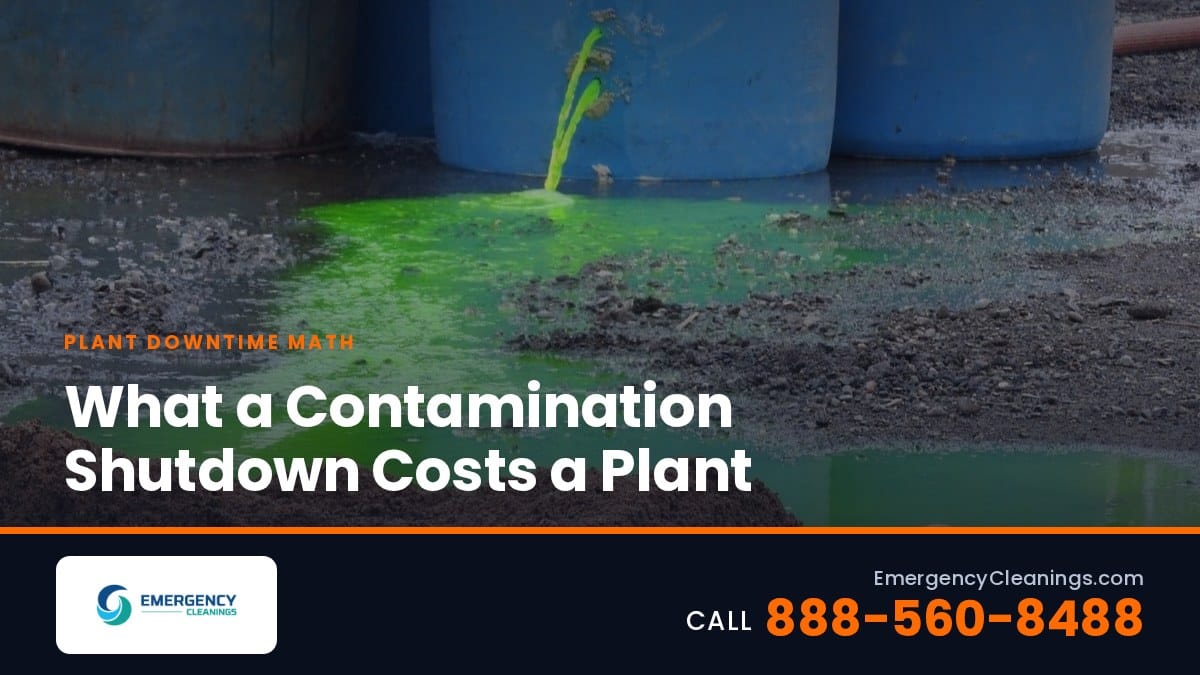
The cost of an unplanned facility shutdown for contamination comes from four places: throughput you lose while the line is down, crews you pay to stand around, reporting and waste obligations that start the moment the release happens, and the restart checks before product moves again. Cleanup is usually the smallest of the four. Emergency Cleanings shortens the other three by getting a crew on site fast and locking one flat cleanup price before work starts, so your downtime estimate has one fewer unknown.
Start with the number your plant already knows
You do not need an industry survey to price your own downtime. You already have the inputs. Take your normal hourly output on the affected line, multiply it by contribution margin per unit, and multiply that by the hours the line sits. That is lost throughput.
Then add labor. Operators on the clock with nothing to run still get paid. So do maintenance techs waiting on a clear area. If the outage runs past a shift, the recovery almost always means overtime to catch up on orders you missed.
Now look at what sits downstream. A contaminated packaging area can starve a warehouse. A spill in a shared corridor can close two lines that never touched the product. Walk the physical footprint and count every area that stops because this one did.
Many downtime cost figures you see online come from equipment vendors selling monitoring software. We left them out on purpose. Your plant controller will ask where any number came from.
The regulatory clock starts before the cleanup does
This is the part people underestimate, because it runs on hours and nobody on the floor is watching it. Rules vary by state, and none of this is legal advice. Check with your EHS counsel on your specific release.
- Hazardous substance releases. Under 40 CFR 302.6, the person in charge of a facility must notify the National Response Center immediately after learning of a release at or above the reportable quantity within any 24 hour period.
- State and local notice. EPCRA rules at 40 CFR 355 Subpart C require immediate notice to the Local Emergency Planning Committee and the State Emergency Response Commission for covered releases, with a written follow-up as soon as practicable.
- Oil reaching water. Under 40 CFR 110.3, a discharge that leaves a film or sheen on water or adjoining shorelines counts as harmful. A floor drain that runs to a ditch can turn a building spill into a water spill.
- Injuries. If anyone was hurt, 29 CFR 1904.39 requires reporting a work-related fatality to OSHA within 8 hours and an inpatient hospitalization, amputation or loss of an eye within 24 hours.
Each of those notices pulls your EHS lead off the recovery for hours. Budget for that time the same way you budget for idle operators.
Waste costs that arrive weeks later
The absorbent, the contaminated pallets and the rinse water all have to go somewhere. If the material spilled was a listed or characteristic hazardous waste, the cleanup residue may be too. That can push your generator count for the month into a higher category, with more paperwork attached.
EPA wrote a relief valve for this. Its episodic generation rule lets very small and small quantity generators handle one event per calendar year, including an accidental spill, without changing category. For an unplanned event you contact EPA within 72 hours, and the waste has to be shipped within 60 days. Your state has to have adopted the rule for it to apply, so confirm that first. If you already used your one event this year for a planned tank cleanout, the spill does not get the same treatment.
Ask any cleanup contractor for disposal records you can request later. When an auditor asks where the drums went two years from now, you want to hand over a folder.
Restart is its own line item
A clean floor does not mean the line can run. On a process covered by the Process Safety Management standard, 29 CFR 1910.119(i) requires a pre-startup safety review for modified facilities when the modification is big enough to change process safety information. If the cleanup meant pulling equipment or swapping components, plan for that review.
The same standard, at 1910.119(h)(2)(i), requires you to obtain and evaluate a contractor’s safety performance and programs before they work on or near a covered process. Plants that finish that evaluation for a cleanup contractor during a quiet month skip it on the day of the spill.
If contamination got into a tank, pit or vault, the confined space standard adds steps. 29 CFR 1910.146(c)(8) requires the host employer to tell the contractor about the space’s hazards, coordinate entry, and debrief the contractor when entry ends. The contractor has matching duties under (c)(9). Build the debrief into your restart schedule so it does not become the thing holding up the first run.
Where the cleanup contractor changes the math
Your biggest cost is hours of downtime, so the contractor question is mostly a timing question. How fast can someone be on site, and how fast can you get a firm number so purchasing can cut the PO?
Emergency Cleanings runs industrial cleanup through vetted local technicians with a same-day response and a 2-hour arrival window. You get an ETA text when the technician is en route. The technician walks the area with you and photographs it. A Project Coordinator then calls with the exact final price and a step-by-step plan. It is one flat fee covering labor, disposal, transportation, equipment and insurance. You approve it, and work often starts the same day.
That fixed number matters when you are writing the incident cost report. An hourly crew that runs long makes your estimate wrong twice. For a liquid release, our spill cleanup service follows the same process. If your team is still deciding what to handle in house, this guide on spill kits versus contractors walks through that call. For broader plant work, see hazard cleaning for manufacturing and chemical facilities.
If your site requires contractors to hold a particular prequalification or safety network status, raise it on the first call. Knowing that before the crew rolls saves a wasted trip.
Frequently Asked Questions
What is usually the largest cost in a contamination shutdown?
Lost throughput. Hourly output times contribution margin times hours down will almost always outrun the cleanup invoice. Idle labor and recovery overtime usually come next.
Do I have to report a chemical spill before cleanup starts?
If the release meets a reportable quantity, federal rules require immediate notice to the National Response Center under 40 CFR 302.6, and EPCRA may require immediate notice to your local and state emergency planning bodies. Rules vary by state, so confirm with your EHS counsel.
Will spill cleanup waste change my hazardous waste generator status?
It can. EPA’s episodic generation rule lets very small and small quantity generators manage one planned or unplanned event per calendar year without changing category, if your state has adopted it. You contact EPA within 72 hours of an unplanned event.
How is industrial cleanup priced by Emergency Cleanings?
One flat fee covering labor, disposal, transportation, equipment and insurance. The final price is set after an on-site walkthrough and locked before any work begins. Work is never billed hourly.
If contamination has a line down right now, call 888-560-8488. You get a same-day response, a free assessment on site, a written scope, and one flat price locked before work starts.