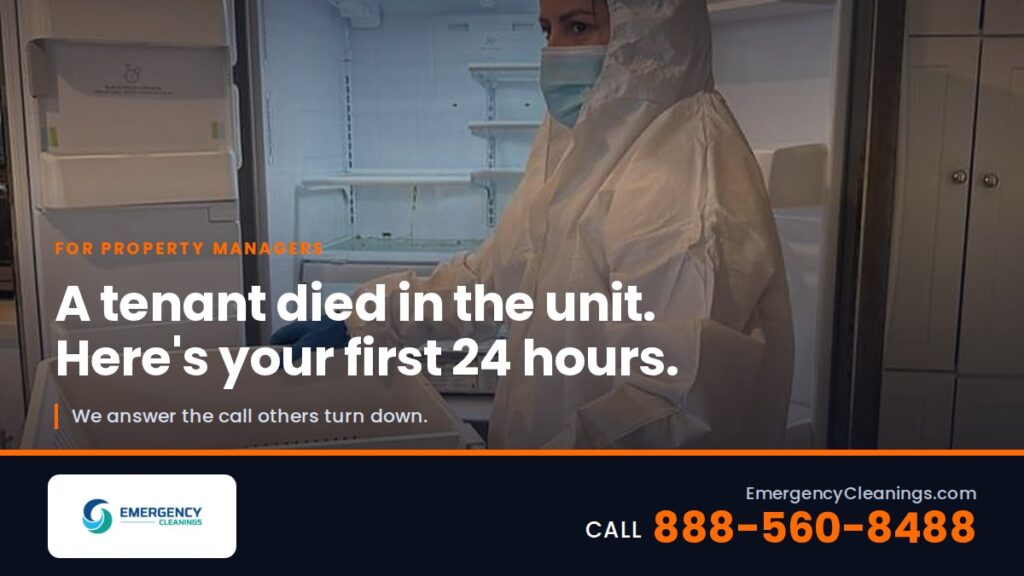
A tenant death in a rental property is a biohazard event, not a turnover. Nobody enters the unit until the coroner or medical examiner releases it, and once it is released the cleaning is regulated work that maintenance staff are not covered to perform. Emergency Cleanings handles after-death and unattended death cleanup for property managers nationwide, with a technician scoping the unit on site and a flat price locked before work begins.
Most property managers will handle a tenant death at some point in their career. Very few have a written procedure for it, and the first few hours are where the expensive mistakes happen — usually with the best of intentions, usually by sending a maintenance tech in to “see how bad it is.”
Here is the sequence that keeps you, your staff, and your owner out of trouble.
Hour 0–1: Nobody goes in
Once law enforcement or the coroner has been called, the unit is not yours to enter. Beyond the legal question, there is a health one: decomposition releases fluids into flooring, subfloor, and wall cavities, and those fluids are regulated material the moment they involve blood.
Your maintenance staff are almost certainly not covered to touch it. OSHA’s Bloodborne Pathogens Standard (29 CFR 1910.1030) applies to employees with reasonably anticipated exposure to blood or other potentially infectious materials, and OSHA has specifically confirmed the standard reaches contractors performing cleanup work. In a 2007 letter of interpretation, the agency also rejected the idea that a delay makes a scene safe — hepatitis B can remain infectious on environmental surfaces for more than a week.
Practical version: if your tech does not have a written exposure control plan, hepatitis B vaccination, and the training records to prove both, sending them in creates an OSHA problem on top of a biohazard problem.
Hour 1–4: The scene is released before it is cleaned
The coroner or medical examiner controls the unit until the body is removed and the death is classified. That release is the starting gun — not the 911 call. Ask the responding officer or investigator directly: when is the unit released, and to whom? Write down the answer and the name of the person who gave it.
Do not let anyone — family, a neighbor with a key, a well-meaning resident manager — remove property before that release.
Hour 4–12: Secure, document, notify
- Re-key or lock the unit. A death in a building travels fast, and unsecured units attract both grief and theft.
- Photograph everything from the doorway. Wide shots, no entry. You are documenting condition at release, which is what your insurer and the estate will ask about later.
- Notify your owner in writing the same day, with the scope of what is known and what is not.
- Do not contact next of kin about belongings yet. Their first call from the building should not be a logistics call.
- Shut down HVAC to the unit if the system is shared. Odor migration into neighboring units turns one vacancy into three.
Hour 12–24: Get a remediation contractor on site
Every hour after release costs you in absorption. Fluids move down and outward — carpet to pad to subfloor to joist — and the difference between a two-day remediation and a two-week reconstruction is usually just how long the unit sat.
When you call, have four things ready: the unit’s square footage and flooring type, whether the unit is on a slab or over a crawlspace, the approximate time between death and discovery, and whether HVAC is shared. Those four answers determine the scope more than anything else you can tell us.
A qualified contractor should walk the unit before quoting. Anyone who gives you a firm number over the phone is either guessing or planning to change it later.
What you owe the next tenant
Disclosure rules are state law, and they vary widely. California is the clearest example: Civil Code § 1710.2 says an owner or agent need not disclose a death on the property — or its manner — if it occurred more than three years before the prospective tenant’s offer to lease or rent. Inside that window, the safe reading is that it is disclosable. The statute also makes clear you may never intentionally misrepresent the facts in response to a direct question, regardless of how much time has passed.
Check your own state before you write your policy, and check whether it treats rentals the same as sales. Many do not.
Who pays
The three usual sources are the owner’s property policy, the deceased tenant’s estate, and — where the death was a violent crime — a state victim compensation fund. These are not mutually exclusive, and the order you pursue them in matters. Document the loss thoroughly before anyone bills anyone.
Emergency Cleanings works on a flat fee. A technician scopes the unit on site, we settle the price and scope with you before work starts, and that price does not move afterward. No hourly meter, no change orders after the fact.
Frequently Asked Questions
How fast can a crew get to the unit after a tenant death?
Same-day response is the norm. Once the job is booked you get a two-hour arrival window, and a text with the technician’s ETA when they are on the way. Call as soon as you know a death has occurred, even if the coroner has not released the unit yet.
Can my maintenance staff clean the unit instead?
Not without an exposure control plan, hepatitis B vaccination, and documented bloodborne pathogen training. Cleaning a death scene puts your employee in contact with regulated material and puts you in front of an OSHA question you probably cannot answer. Bring in a crew that already carries the training and the disposal chain.
Do I have to tell the next tenant that someone died in the unit?
That depends on your state, and the rules are not uniform. California Civil Code 1710.2 sets a three-year window for disclosing a death on the property, and other states handle it differently or not at all. Read your own statute, and never misrepresent the facts if a prospective tenant asks you directly.
How does pricing work when the owner has not approved anything yet?
The assessment is free and a technician scopes the unit in person before any number is given. Emergency Cleanings quotes a flat price for the agreed scope, locks it before work begins, and it does not change afterward. Financing is available, and larger jobs can be phased if the owner wants to approve the work in stages.
If you are standing outside the unit right now
Call 888-560-8488 for a same-day response. Emergency Cleanings handles after-death and unattended death cleanup and emergency cleanup for property managers nationwide. The assessment is free, a technician scopes the unit on site, and the flat price is locked before any work starts.