Hoarding cleanup for landlords starts with the lease and the Fair Housing Act, then moves to the unit itself. If the tenant is still there, you may owe a reasonable accommodation such as time to clear the unit before an eviction goes forward. Once the unit is legally yours again, Emergency Cleanings can walk it, set one flat price, and clear it to a clean, empty shell ready for repairs and a new tenant.
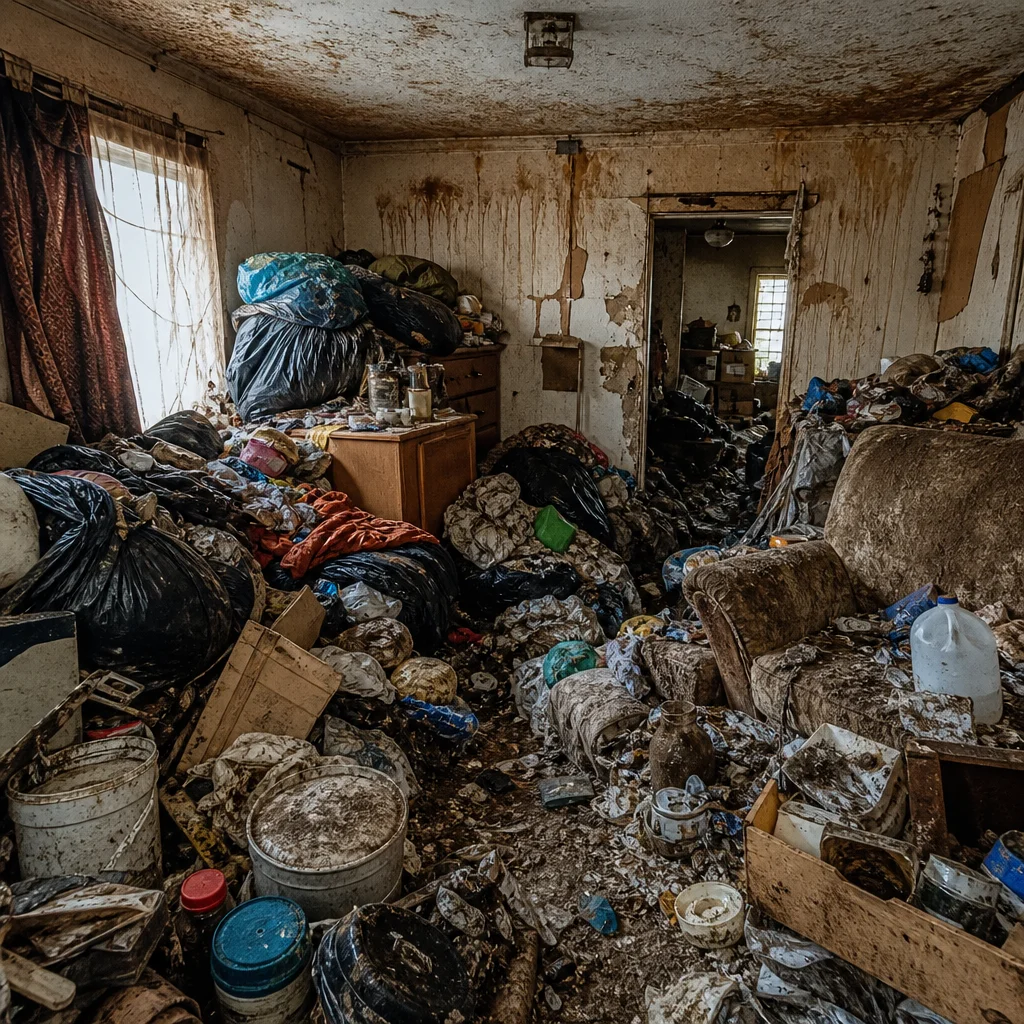
You found out on a maintenance call. The door opened and the unit was stacked to the ceiling. Now you have a tenant with legal protections and a building you need back in service.
This guide is for the owner of a house or a small rental who has to handle both halves, often from another city. It picks up where our post on the legal responsibilities of landlords in hoarding situations left off and walks through the order of operations. Rules on notice, eviction and left-behind property vary by state, and nothing here is legal advice. Talk to a local landlord-tenant attorney before you file anything.
Why a hoarded unit is a liability problem first
The American Psychiatric Association describes hoarding disorder as persistent difficulty parting with possessions because of a perceived need to save them. It estimates prevalence at about 2.6 percent, with higher rates for people over 60. The same page lists fire hazards, tripping hazards and health code violations among the consequences.
Stacked paper next to a baseboard heater is your building burning. A blocked exit path is a firefighter who cannot get in. Leaks under a sink go unseen for months because nobody can reach the cabinet, and the subfloor rots while you collect rent. In a duplex or a small building, the neighbor next door lives with the pests and the odor, and the neighbor calls you.
So the first job is a look at the conditions with your own eyes or through someone you trust. Give the notice of entry your lease and state law require. Take dated photos of every room, the exits, the kitchen, the bathroom, and anything touching a heat source.
The Fair Housing Act question comes before eviction
Hoarding disorder has its own diagnosis in the DSM-5. A 2015 article in the Journal of the American Academy of Psychiatry and the Law points out that this change opened the door for tenants with severe hoarding to request reasonable accommodations from landlords, because the condition can qualify as a disability under fair housing law. You do not diagnose your tenant. You respond when the tenant, a relative or a caseworker asks for time or help.
The federal Fair Housing Act makes it unlawful to refuse reasonable accommodations in rules, policies, practices, or services when they may be necessary to give a person with a disability equal opportunity to use and enjoy a dwelling. The same section, at 3604(f)(9), says the law does not require renting to someone whose tenancy would be a direct threat to the health or safety of others or would cause substantial physical damage to the property of others.
The Joint Statement of HUD and the Department of Justice on reasonable accommodations, issued May 17, 2004, fills in how those two pieces fit together. A few points from it matter most to you:
- A request does not have to be made in a particular way or at a particular time. It can come up after you have served notice.
- A direct threat finding has to rest on an individualized assessment based on reliable objective evidence. Your dated photos are that evidence.
- You can ask for reliable disability-related information when the disability is not obvious, and for the link between the disability and the accommodation requested.
- You can deny a request that would impose an undue financial and administrative burden or fundamentally alter your operations, and you should discuss alternatives before you say no.
- In one of the statement’s own examples, a manager facing a direct threat only has to grant the accommodation if there is satisfactory assurance the threat will be eliminated.
In hoarding cases the common accommodation is time. The JAAPL authors describe a case where the accommodation was a stay of eviction long enough to get the premises cleaned, with the court setting a time limit. For you, that looks like a written plan: a date for a reinspection, the specific conditions that must be corrected, and what happens if they are not.
A tenant who agrees to clean can hire help. Some ask a crew like ours to come in on a phased schedule, a room at a time, with photos of each finished phase. That gives you something measurable at the reinspection. If the tenant needs support beyond the cleanup, the International OCD Foundation’s hoarding resources list local task forces and treatment providers. Cleanup is not treatment, and a unit cleared without support behind it can fill up again.
After the tenant leaves: what you can and cannot throw out
Maybe the plan did not hold. Maybe the tenant moved out on their own. Either way, the unit is full of someone else’s belongings, and in most states you cannot back a dumpster up to the door the next morning.
States set their own procedures for property left behind. California is a useful example of how specific they get. Under California Civil Code section 1984, the notice to a former tenant must give a reclaim deadline of not less than 15 days after personal delivery, or not less than 18 days after mailing. Other states use different clocks, and some treat property differently after a court-ordered lockout than after a voluntary move-out. Get the rule for your state from your attorney and mark the date on your calendar.
While you wait, you can still act:
- Photograph and video every room again, with the date visible.
- Secure the unit and change the locks if your state and your judgment allow it.
- Deal with anything that is a live hazard, such as spoiled food, standing water or pest activity, and document why.
- Line up the cleanup so the crew can start the day the holding period ends.
A hoarded rental that sits empty for three weeks waiting on a legal clock, then another two weeks waiting on a contractor, has lost five weeks of rent. Book the walkthrough during the holding period.
What a hoarding cleanup looks like when the unit is a rental
A junk hauler quotes by the truckload and leaves when the floor is visible. A hoarded rental usually needs more than that. Once the stacks come out, you find rodent droppings behind the stove, urine in the carpet from a pet nobody knew about, and a bathroom that has not been cleaned in years. Our post on trash-out versus full cleanout covers where that line falls.
Here is how the job runs with Emergency Cleanings on a hoarding cleanup:
- You call and describe the unit. We set a 2-hour arrival window and text an ETA when the technician is on the way.
- The technician walks the unit and photographs every room. You do not need to be there. A lockbox code or a property manager with a key is enough.
- A Project Coordinator calls you with the exact final price and a step-by-step plan. The price is one flat fee covering labor, disposal, transportation, equipment and insurance. It is locked before work begins and does not move.
- You approve, and work often starts the same day.
- The crew sorts as it goes, setting aside documents, keys, photographs, cash and anything that looks like it matters to the former tenant, so you can handle them under your state’s rules.
- You get photo documentation of the finished unit, plus disposal records you can request.
If the budget is tight or the unit is large, the work can be phased room by room at a fixed price per phase. Financing is available. Unmarked vehicles are available on request when you would rather the rest of the building not see a crew hauling out a neighbor’s life.
Surface mold gets cleaned as part of the work. Deep mold mitigation, water damage restoration, fire restoration, plumbing repair, and rebuilding are separate trades that Emergency Cleanings does not perform.
Getting the unit back on the market
When the crew leaves, walk the unit or have someone walk it for you with a video call running. Check the spots the stacks hid: subfloor under the kitchen sink, window frames, the backs of closets, the water heater closet. Build your repair list from what you see, then send it to your contractors with the photo set attached.
Keep the whole file together. Your entry notices, the before photos, the accommodation correspondence, the reclaim notice, the cleanup photos and the disposal records tell the story if the former tenant ever disputes what happened.
Frequently Asked Questions
Can I evict a tenant for hoarding?
Often you can if the conditions violate the lease or local codes, but federal fair housing law may require you to consider a reasonable accommodation first, such as time to clean. Eviction law varies by state, so talk to a local landlord-tenant attorney before you file.
Do I have to be at the property for the cleanup?
No. A lockbox code or a local contact with a key is enough. The technician photographs every room during the walkthrough, the Project Coordinator calls you with the price and plan, and you get photos of the finished unit.
How soon can I throw out what a former tenant left behind?
That depends on your state. California, for example, requires a reclaim deadline of at least 15 days after personal delivery of notice or 18 days after mailing. Check your state’s rule before anything is discarded.
Will the cleanup price change once the crew starts?
No. Emergency Cleanings sets one flat price after the on-site walkthrough, and that price is locked before work begins. Larger jobs can be split into phases with a fixed price for each phase.
If you have a hoarded unit you need back, call 888-560-8488. We offer same-day response and a free assessment on site, then send a written scope and one flat price that is locked before work starts.